
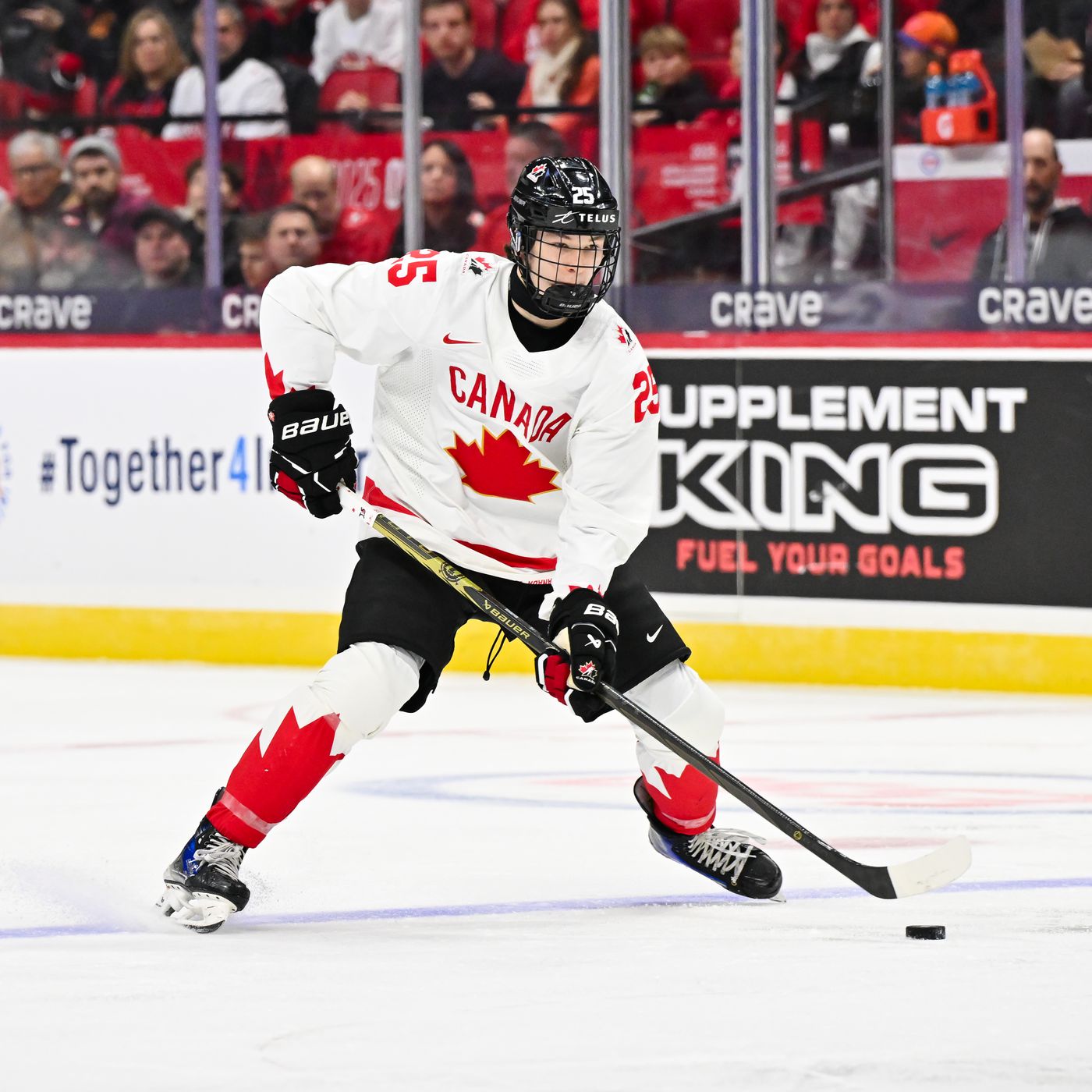
The 2025 NHL Draft is now just a day away, and with anticipation at its peak, we’re proud to unveil our latest evaluation of this year’s draft class. Our Top 100 Draft Guide represents months of hard work, dedication, and collaboration among our scouting team, who have watched, analyzed, and debated every angle of this intriguing class of prospects. This year, we’ve opted to focus our guide exclusively on the top 100 players—providing coverage of those expected to be taken across the first three rounds, with four additional standout players as well.
Whether you’re reading this the night before the draft, following along as the picks come in, or checking back afterward to learn more about who your team selected, we built this guide to be a useful tool throughout the entire draft process. We are extremely proud to finally unveil our official top 100 for the 2025 NHL Entry Draft.
1. Michael Misa (C) – Saginaw Spirit
Michael Misa had a truly exceptional year. The former CHL exceptional status player is a legitimate dual-threat player and a dynamic center who projects to be an elite top-line pivot at the next level. I feel like it’s a cop out to say a player has no weaknesses, but with Misa, it is hard to find any. He has a pro-ready shot, allowing him to score goals in a variety of ways and be a constant shooting threat all over the ice. Even more impressively, his playmaking and vision allows him to pull off highlight-reel plays and make the lives of his wingers that much easier. Physically, his frame and strength even allow him to compete along the boards and around the net, while his skating ability is high end and helps him carry the puck up the ice and join the attack. He is about as safe of a bet as there is to become an impact player in the future and there is very little doubt in his ability to become a star at the next level. – Gordon Munro
Misa is a dangerous offensive presence. He’s much stronger in the faceoff circle than in the first half of the season. He’s got a quick and effective set of hands, but he sometimes tries to do a bit too much on his own. His first step is also very good and to generates momentum. His edgework is simple, but efficient, the embodiment of less being more in terms of the way he moves. His compete level also does need work off the puck. On the puck, he’s gonna make people stand out of their chairs. There’ll be times where he can get close to being in your face, but he needs to be more confident with his stick. I feel he’s hesitant to finish his checks or use his stick on the forecheck because he wants that extra step if he forces a turnover, since he knows his ability to turn on the jets is that good. He sets himself up for grade-A chances, but sometimes in very risky situations where there’s a good chance the puck is picked off. Sometimes, it’s in situations where highlight-reel goals can and will be scored. Despite the minor holes, it’s normal for a player his age to need room for improvement. His offensive floor is very good with a heavy shot, and it’s clear to see how he scored over 60 goals this season. He’ll hear his name early on Friday night. – Tomas Zubrus
2. Matthew Schaefer (D) – Erie Otters
Matthew Schaefer is arguably the best and most exciting blueline prospect in years and has the chance to be the first defender chosen first overall since Owen Power in 2021. Despite playing less than two dozen games in his draft year, what he showed in his limited time was nothing short of remarkable. He is an elite skating, two-way defenseman who is equally adept in all three zones, possessing the ability to kill opposition offence while also creating it for his team. In a single shift, he can deny an opponent’s zone entry, carry it up the ice across both bluelines, deking out multiple opposing defenders before placing a saucer pass directly on a teammate’s stick for a grade-A chance. He is an electrifying player that projects as a true top pairing defender with the ability to play in all situations and log big minutes. – Gordon Munro
It’s been a long time since a defenceman has been as unilaterally praised as Matthew Schaefer. His profile lacks nothing, bringing the frame, skill and tools necessary to play his game at higher levels; but what makes Schaefer the first overall pick favorite falls squarely on how high-end his core strengths are. Schaefer is arguably the best skater the draft has to offer. He brings a high-end ability for everything you can look for, fluid stride, sharp on his edges, explosive in a straight line, agile in all four directions. There’s virtually nothing keeping Schaefer from where he needs to be at any given moment, something made evidently clear by how often he’s able to jump on the rush. The threat of this skill is amplified by Schaefer’s immaculate playmaking ability. He’s without a doubt, the best offensive defencemen in this class. On breakouts, Schaefer takes off like a rocket hitting the neutral zone with unmatched speed, incorporating every trick in the book to deceive and influence oncoming pressure. Once he hits the offensive zone, Schaefer’s a bonafide triple-threat, capable of continuing his rushes and getting the puck down low, firing from range with his deceptively powerful shot, or finding a teammate. Big emphasis on the latter; Schaefer’s passing game is another class-leading skill, but it’s how well it blends in with his other tools that makes Schaefer so dynamic. He constantly finds ways to create passing lanes with his hands and feet and darts the puck through as soon as the gap is presented. Even with all this talent, Schaefer has added value away from the puck, aggressively closing gaps and space, anticipating and intercepting plays, closing distance with his stick before engaging physically. Some physical development may be necessary before Schaefer
It’s easy to see how he’s won over so much of the consensus when you consider how much of a differential he provides from the rest of the top of this class. In a year where there aren’t as many highly regarded defencemen nor a ton of late 07s at the top of the board, the market definitely favors Schaefer’s value regardless of his 26-game sample size. Regardless of the draft’s meta, Schaefer’s demonstrated real potential to become a franchise defenceman and has earned his spot at the top of this year’s class. – David Saad
3. James Hagens (C) – Boston College
If you are looking for a dynamic, two-way pivot, James Hagens is your guy. Despite what many see as a struggle to produce this past year, going point-per-game in the NCAA is an incredible feat as a DY player. Combined with his stellar play at the 2024 U18s, the World Juniors over the holidays, and historically with the USNTDP, the supposed lack of production should not be as big of a concern as it is for some. Hagens is arguably the draft’s smartest player. He boasts an incredibly high hockey IQ, typically thinking one or two plays ahead of his opposition. He roams the ice like a hawk, waiting to expose opposing players weaknesses and steal pucks. From here, he can make magic happen either through his creative playmaking or his near pro-ready shot. He is also one of the draft’s best skaters, giving him the ability to make highlight-reel plays, giving even more weight behind the Jack Hughes comparisons. At this stage, Hagens projects as a first-line center, who is responsible and can play all 200ft of the ice surface. – Gordon Munro
Coming into this season as the consensus #1 prospect, Hagens proceeded to have himself a season at Boston College, putting up a point-per-game statline on a stacked BC squad. His playmaking was on display all season and will become the hallmark of his game at the next level. His skating prowess also made him an excellent transition forward, setting up his linemates, Leonard and Perreault, with countless chances. Another deadly asset in his repertoire is his stickhandling talent, carving up defenders and giving himself extra room to make passes. All of this played a crucial factor in his season with BC, but were most impressive at the World Juniors. All in all, given the pedigree shown this season and the extremely high potential shown off, James Hagens might have the highest upside in this draft, and the successes of Jack Hughes and Logan Cooley outline his career trajectory quite well. – Linc Zdancewicz
4. Caleb Desnoyers (C) – Moncton Wildcats
The thing that sticks out the most about Desnoyers is that he doesn’t really do anything poorly. He’s the most well-rounded center prospect in the draft and he improves every line he’s put on. High hockey IQ and good vision are paired with slick hands and strong on-ice awareness. He directs play rather than forcing it. That saddles him with a bit of a reputation of not being a true play driver, but I think that’s a little overblown. He demonstrates a willingness to adjust his tactics as the situation demands and he uses that discretion to help dictate the pace of play. If this means he has to get in hard on the forecheck, he does it. If the situation demands that he play out a little higher, acting as a 3rd defender, he can do that too. This versatility makes him a slam dunk pick, he will be on your roster, helping your team sooner rather than later. – Jack Dawkins
Desnoyers is a smart, playmaking centre who has a beautiful stride that generates a lot of power. His straight-line speed is great and has a very dangerous shot that he can use on that speed. He competes very hard and isn’t afraid of physicality. His puck control is superb. He can be very effective at both ends, and is incredible in the faceoff dot. Desnoyers’ IQ with the puck is good, but off the puck, it’s amazing. His defensemen likely breathe a sigh of relief when they see him on the ice, as he’s one of the more defensively responsible playmakers in this whole class. He seems to be 3 steps ahead and always seems to know where the puck is headed. He has no trouble executing plays especially when finding the best passing option available, he’ll do everything he can to help his team win. I think he’s a perfect fit in a QMJHL Top-6 that can play first line on most teams and on the PP + PK, no questions asked. He projects to be an early 1st round pick and a potential NHL first/second-line centre. – Tomas Zubrus
5. Porter Martone (RW) – Brampton Steelheads
Porter Martone is about as much of a unicorn in a winger as you can get. He boasts a large 6-3, 205lbs frame, which he is not afraid to use, especially in front of the net but his bread and butter is his offensive ability. Through 57 games, the Mississauga Steelheads captain recorded 37 goals and 61 assists for 98 points this past season. This season also saw him represent Canada on the international stage at various tournaments; The Hlinka Gretzky, the World Junior Championships, and play up with the Men’s World Championships. He is a high-end playmaker who possesses some very real dual threat capabilities and a pair of silky mitts. He has the vision and creativity to find open seams and thread the needle, pulling off some incredibly high-end plays. His shot is almost as exciting, allowing him to fire off seeing eye shots into the back of the net. I do have my reservations about Martone’s game — specifically, his decision-making and compete at times. Regardless, he is no doubt a highly skilled winger and should be able to become at least a top-six winger at the next level. – Gordon Munro
Porter Martone is amazing, and he’s getting noticeably better. Martone’s vision is remarkable. His playmaking ability is a highlight of his game, as he can find his teammates in otherwise unthinkable, dangerous spots. In space, Martone is a sniper, with an extremely powerful and deceptive shot. The highlight of Martone’s game, though, might just be what he can do to carry the puck. His stickhandling and creativity made OHL defenses miserable, and it is clear that he can be the guy to carry the puck into the zone. What ties this high-level package together is his size. Martone is 6’3 and 207 pounds. This will be impossible for teams to ignore.
And yes, as I said before, he has improved. The pace of play was an issue for me earlier in the season, but he has turned up the dial, pushing play at an NHL pace at times. Martone can be extremely comfortable with the time and space he gets at the OHL level. I do think he’s working on it, though. Even playing at the senior international level, Martone might not have been dominant, but he was clearly smart enough to succeed at this level already, even at his young age.
The skating scares me a bit, but I think it will continue to improve. I think there is so much more power to be harnessed from Martone’s skating. However, if he can become more powerful and really push play with barrelling force, that will be huge, as NHL competition is big enough to limit what he can do with just his hands and brain. Martone isn’t the traditional complementary player, but rather, he can be a supporting star. The difference, in my opinion, is that he is perfectly capable of pushing play by himself and getting results. However, it will be hard for NHL teams not to imagine him taking the pressure off of their franchise star. Martone can carry the puck, he’s smart enough to play with the superstar 1C, and skilled enough to find the star too. If you’re a team like Chicago, and you’ve seen what Connor Bedard can do despite being limited by quality of linemates… how can you resist getting him a player like this? If you’re a team picking Martone here, are you looking at what Mikko Rantanen is doing with Dallas in the playoffs? The leap is big enough where I wouldn’t be comfortable expecting that from Martone, but the team picking him will surely hope for it. Instead, though, a team really can’t be upset if they get a Power Playmaker in the mould of Blake Wheeler out of a player like this. – Taahaa Lone
6. Victor Eklund (LW) – Djurgardens IF
Victor Eklund has been as consistent as one could ask from a player in their draft year. A late-’06, Eklund has been in my top-ten since day one and has continued to be one of the best draft eligibles in Sweden this season; showing his capability to play in any role thanks to his performances for Sweden and Djurgårdens.
Eklund is a player you could argue is a coach’s dream. He is capable of playing so many different roles from an offensive producer to a set-up man and, as he showcased at the World Juniors, a hard-nosed grinding winger who is willing to dig pucks out of the corner and work the cycle. I really like his forechecking ability and I think with some added muscle to his frame he could add an element of physical play to be more punishing when getting in on the forecheck. Although I don’t think Eklund will reach the offensive potential that fellow Djurgårdens teammate Anton Frondell is projected to have, he’s someone I feel who is going to at worst be a 3rd line scoring winger who gets in on the forecheck and helps to establish the cycle. I also think he’ll be someone a coach is able to move up and down the bench with ease and have him play different roles in a lineup. – Alfonso Acevedo
For the first half of the season, you could easily make an argument Victor Eklund was not just the best draft-eligible player in Europe, but by a fairly hefty margin. Now, he looks quite fairly close in battle with teammate Anton Frondell, who exploded in the second half. Still, Eklund cannot be discounted in his talent level either. The growth of Eklund’s older brother William, a top-six forward with the San Jose Sharks, gives some positivity towards the younger Victor’s ability to take his game to a higher level in the future. Victor doesn’t appear to be as advanced and flashy as William at the same age, but has a lot more craftiness to his game. Victor doesn’t actually seem to play too similar to William, they’re both highly nifty wingers with strong stickhandling and quickness to their game, but Victor feels like someone who draws the game to him when he has the puck. He has good puck control and doesn’t let up on plays despite not being the strongest player. Eklund is a good shooter who seems to have a real pop in his shot, especially from distance — something that could become a standout tool. Against men, Victor has been able to make up for the lack of strength with good deceptiveness and the ability to elude opponents, making him hard to contain. He does lack physicality, which can make players catch him when they can and have him cough up the puck. It did seem like at times in the second half of the season that Eklund was getting a little more beat down as the heavy workload against men starting to wear on him, but he persevered and continued to compete on course. It’s hard to not see Eklund as an NHLer, and there’s a very real chance he’s in a team’s top-six, with the ceiling of a first line forward. – Austin Kelly
7. Anton Frondell (C) – Djurgardens IF
Frondell is a fascinating case study. Troubled with injury throughout the season, it took a monster run in the Allsvenskan for him to re-solidify his top-10, top-5, or maybe even top-3 hype.
What Frondell is stylistically is up for debate, but the one that’s won me over is that of an off-puck Swiss-army-knife. The way he creates space with his physical tools and combative nature is constantly noticeable. Even if it doesn’t result in advantages for himself, Frondell takes proactive action tying up sticks and taking bodies away from lanes to create space for teammates to distribute the puck. Off the rush, Frondell’s very well measured in his routes, matching speeds with his linemates in the neutral zone before charging for the net. Once he gets there, Frondell isn’t shy from doing the dirty work, laying screens and fishing for rebounds amidst the sea of bodies. This isn’t generally what high-end prospects do nor is it seen as a generally appealing way to play for those players, but Frondell sticks to what he knows and he does it well. The added offensive dimension of his finishing ability gives Frondell a little bit more oomph. His wrist shot has a deceptively fast release and his one-timer is a weapon worthy to slot on his future team’s top power-play. With this skillset, it’s easy to see Frondell land somewhere in a top-6. You can pair him with pretty much anyone and he’ll find a way to contribute to the line’s dynamic. That said, I think he’d be better off as a winger as Frondell lacks the strong transition play and handling needed to be a primary puck carrier. Frondell, may never be the loadbearing weight on a line, and that’s fine. He may be a bit underwhelming in the skill department, but the intelligence, two-way effort and physicality should keep him employed in the NHL for years to come. – David Saad
Once seen as the best player in the draft out of Sweden coming into the draft, Frondells season has been very much a roller coaster ride. Struggling with an injury scare early in the year, then being cut from the World Junior team, it has not been the season he and many others expected. All that aside however, Frondell has a tone of potential.
Frondell already possesses the size of an NHLer and I feel with another year of play for Djurgårdens pro team, who will play in the SHL after earning promotion this season, he could be NHL ready by next season. The biggest thing with Frondell that I have come to love is his ability to spin off checks while leveraging his size to protect the puck. I’m not sure there is another player in this draft that does this as well as Frondell. Now as much as he is capable of spinning off checks, his willingness to get physical along the wall or in the corners is another story. I find he can be somewhat timid when going into board battles and tends to ease himself into battles in the corners. I do believe however that with another year playing pro in Sweden he will become more comfortable using his size to his advantage.There are some who have likened him to another Swedish player in Leo Carlsson however, I do not believe Frondell is on the same level. I see Frondell in more of a 2nd line power forward who uses his frame and size to get into space and crash the net; creating offense from getting into traffic. – Alfonso Acevedo
8. Jake O’Brien (C) – Brantford Bulldogs
O’Brien was one of my early favourites for this year’s draft. The 6’2 center possesses such elite vision and overall high-level playmaking that he constantly creates plays each shift. He is able to find such tiny gaps around the ice, whether it is between defenders, under sticks, or through loads of traffic. Mix in his flashy puck skills, and it gives him all the tools he needs to be a 2C at the NHL level. However, if O’Brien wants to reach his full potential, his skating will need a bit of work. He isn’t necessarily a bad skater, but he lacks the pace that some elite talents in this draft possess. If he were to spend some time improving his speed, it would propel him to another level. The other area that O’Brien could improve to make him a more dynamic offensive threat would be his shot. Thirty-three goals in the OHL for his DY is no joke, but his release and shot power isn’t quite at the NHL level yet. Overall, when you take JOB’s ability to drive play through the middle of the ice, and his solid defensive acumen for his age already, you have the makings of a talented middle-six forward, if not a 2C at the NHL level. Any NHL team would be happy if he fell to them outside the top-ten. – Curtis Rines
Jake O’Brien may not be the most dynamic or flashiest player in the draft but he brings a smart and poised performance every time he touches the ice. He impressed last year racking up 51 assists in 61 games as the OHL’s rookie of the year and he somehow improved on that notching 66 in 66 games. He is a tall and lanky centerman standing 6-2 and 177lbs. He possesses a good blend of playmaking and two-way abilities that can see him slot into many different systems and lineups at the next level. He was ranked the smartest player in the OHL amongst league GMs for a reason, he is able to manipulate and deceive at a very high level which adds to his pinpoint accurate playmaking. He will need to refine his game in some areas, specifically his speed and strength but there is a real player here who if all falls right should be a very valuable second line center. – Gordon Munro
9. Justin Carbonneau (RW) – Blainville-Boisbriand Armada
There’s always a place in an NHL prospect pool for a dynamic play-driving, right-handed winger with NHL speed and size. Carbonneau was arguably the most dangerous scoring threat in the QMJHL this year. He doesn’t always dazzle you with his speed, but he’s able to make very quick speed adjustments during the pace of play. He’ll make little deceptive movements to freeze his opponents and create openings for him to exploit, and then he strikes like a pit viper. Sometimes that strike is a dash through the seam for a scoring chance. Other times it’s a seam pass through traffic that lands right on the tape of a teammate. All the while he has the puck on a string. He’s the kind of player that when you see him dash up ice with the puck, you inch a little closer to the edge of your seat and say, “Oh, here we go.” But wait, there’s more. He’s also perfectly happy going to the net front and playing in the “dirty areas” to generate goals. Carbonneau is simply a complete package forward prospect. – Jack Dawkins
Carbonneau is a big, goalscoring right winger that has a great stride that generates a lot of power. His straight line speed is very threatening and has a quick and accurate shot that he can use on that speed along with good puck control. He competes hard and is great on the forecheck. Despite his size, he doesn’t play like he’s 6’3”. Hardly a factor in his own end, turns the puck over a bit too much, and he isn’t physical enough. IQ with the puck is great, he’s a player that can find or create those scoring chances for his teammates despite him being a shoot-first player. I think he’s a good fit in a first line at the QMJHL level that can play on the top PP. For me, he projects to be a late 1st round pick and a potential second line winger at the NHL Level. – Tomas Zubrus
10. Logan Hensler (D) – University of Wisconsin
Hensler has long impressed scouts with his flashy, two-line passing and explosive jumps into the rush. But he wasn’t able to rely on those strengths in a difficult role with Wisconsin – and instead had to learn where his strengths worked best away from the puck. He had his bumps and slips this season, bu emerged in the second half of the year as a strong, physical defender capable of controlling space between corners and slot. He showed an impressive amount of growth from season start to end, and ultimately filled the imposing, top defender role asked of him by his coaches; while still showing the flashes of energetic passing. Hensler projects clearly into a hardy, low-stakes but important pro role thanks to his physical upside and D-zone control. But his passing and jump up the ice give him a layer of exciting potential. – Gabe Foley
There is a reason that Logan Hensler was projected as the best or second best defender heading into the 2025 NHL Draft. The right-handed defenseman possesses a good size frame at 6-2 196lbs but also has a good toolkit with soft hands and mobile feet. He played with the University of Wisconsin Badgers as a freshman this year, racking up a respectable 12 points in 32 games. He shows some sound defensive prowess, using his skating and stick work to keep up with opponents on the rush and is unafraid to battle with opponents. He is good on puck retrievals having the strength and creativity to fight off attackers and throw some deceptive moves to open space and make outlet passes. Most intriguing is the individual skills he possesses that hints at another level of offense that wasn’t fully realized this year. At times, he can look dynamic with the puck on his stick and make plays others just don’t see and find teammates to drive offense. If he can unlock that, the sky’s the limit and a team could be looking at a legitimate top-pair option but he safely projects as a No. 4-6 defender as of right now. As he moves forward, in order to maximize his potential, it would be great to see him put together his tools and take a leap offensively. – Gordon Munro
11. Radim Mrtka (D) – Seattle Thunderbirds
Radim Mrtka started the year overseas in his home country of Czechia, playing in both the top junior league as well as the top men’s league. He came over to spend the second half of the season with the WHL’s Seattle Thunderbirds and very quickly found himself rising up draft rankings. He has a large 6-6 218lbs frame but skates well especially for his size and uses this to his advantage in all three zones. He is able to keep up with opposing players and deny entries and uses his long reach to disrupt opposing players and keep them to the outside. He is then able to transition up ice either through carrying it himself or making crisp passes to his teammates to start the rush. Finally, in the offensive zone, he shows some quick and sound decision making and is able to distribute the puck well to his teammates. It is tough to say at this stage exactly how much of his offense will translate to the next level as that part of his game is still quite raw. That being said with Mrtka, you can guarantee he will be an effective defender albeit a little more docile than some may like but with his good skating, puck movement, and size, there are a lot of traits to like and he should be able to at least play on an NHL second pair. – Gordon Munro
Mrtka is a phenomenal talent. He’s a huge frame and has some awkward skating because of it. But despite that, he shines through as an athletic talent, picking his feet up and driving through play with confidence and aggression. He forces opponents wide and closes the gap on defense. But his bread-and-butter is turning loose pucks against the boards into fastbreaks the other way. His first step is strong and he scans for options while driving the puck through all three zones. He’s also shown plenty of flash when holding the blue-line, taking creative steps into space and unleashing hard shots. Lots to like, though his wonky skating and needed adjustments on defense cause me some pause. – Gabe Foley
12. Brady Martin (C) – Soo Greyhounds
Brady Martin is one of the OHL’s biggest risers this season, going from a second round ranking early on to a near top-10 ranking by season’s end. The most talked about parts of his game is his motor, compete, and physicality giving him a high floor but what makes him worthy of a high draft choice is his offensive game. This is not always the most complex but it is effective, he gets to the net with consistency and like a freight train and is able to score goals in tight. His puck skills and passing ability is the element of his game that if utilized properly could take him the highest, allowing him to play in a top-six role. – Gordon Munro
If your team takes Martin, you’d be forgiven for mistaking Martin for a freight train on occasion, up there with the hardest hitters I’ve ever seen at his age. Grab the popcorn, there’s more. He’s a smooth skater that won’t necessarily wow you with his speed but it’s more than up to par. His hockey IQ does stand out in a good way. Able to read where the puck will be ahead of time and is able to quickly pounce on turnovers. The kid can dictate play, and lead by example as shown by the “A” on his sweater and the way he carries himself on the ice. He’s got a great offensive toolbox to boot and I have no doubt that there’ll be a lot of “#44, Martin” jerseys wherever he ends up in a few years. Top 10 talent in my eyes. – Tomas Zubrus
13. Bill Zonnon (RW) – Rouyn-Noranda Huskies
Zonnon is just built for the NHL playoffs. Endless motor and intense effort are the two qualities that drive everything else he does. It’s all hustle all the time with Zonnon. He pushes the pace of play on the forecheck, on the backcheck and chasing down 50/50 pucks. He’s the kind of work ethic player that coaches dream of having. When he has the puck on his stick he morphs into a smooth handed playmaker. His 83 points through 64 games is a testament to his abilities with the puck. In spite of his all-gas-all-the-time way of playing, Zonnon demonstrates a tremendous amount of patience and vision with the puck. He makes brilliant passes into dangerous areas, setting teammates up with easy finishes. Realistically, the only reason he’s not a top 10 pick in this draft is because of his skating stride. I genuinely love watching this kid play hockey, it’s been a joy to scout him this year. – Jack Dawkins
Zonnon is a smart, playmaking, Winger that has a decent stride which generates power. His straight line speed is good and has a good shot that he can use on that speed. He can throw his weight around well and compete hard, when he feels like it. His hands are pretty good. He’s effective at both ends, keeps the puck close when he has it, and can thread passes from many places that other players can’t. His IQ with the puck is really good. Off the puck, there’s some work to be done but it can be helped. Has issues when the pace of the game is fast. I think he’s a good fit in a top 6 at the QMJHL level that can play PP and PK situations. – Tomas Zubrus
14. Cullen Potter (LW) – Arizona State University
Bursting onto the scene with a dazzling goal in his first series with ASU was only the start with Cullen Potter. Brilliant skating and a ton of stick skill made this jaw dropping prospect so salivating to so many teams. His straightline speed made even the supersonic NCHC look slow in comparison. Zone entries were nothing to the young Potter. Even though he is small in stature, he competes hard and is a smart and driven player without the puck. Cullen even added to his resume with a solid U18’s performance. – Linc Zdancewicz
One of the stronger skaters in the draft. When he takes control of the puck, your eyes will be glued to the kid, the way he controls the puck at top speed as well is incredible for his age. Good positioning in his own zone, but I do feel he sometimes glides around in his own end trying to look busy but perhaps this was a one-off, wasn’t a liability necessarily. Also does need to get stronger on his feet, but that will come with time. He also has a great set of hands and is able to quickly side-step opponents to create space for himself to advance the puck or for feeds to his teammates. Defensively, not going to wow you but his offensive arsenal paired with his skating make him a very intriguing prospect for this Friday’s draft. Expecting him to be a mid to late first rounder. – Tomas Zubrus
15. Cameron Reid (D) – Kitchener Rangers
For my money, Cameron Reid is one of the 2025 Draft’s best defenders possessing a high end, smooth skating two-way game. He only has average size which some will see as a knock but his brain and hockey IQ allows him to overcome this deficit. He should be able to provide value in all situations and if developed properly could be a legitimate top-pairing defender at the NHL level but is most likely a second-pair guy. He is mobile, a good puckmover and with the ability to defend the rush and in-zone using his stick, there is very little that Reid can’t do at a high level. – Gordon Munro
Cameron Reid, like the defencemen at the top of this year’s table, is a smooth-skating, puck-moving defenseman who stands out for his elite mobility and high hockey IQ. While a tad undersized compared to many of his peers, Reid compensates with fluid, explosive skating that allows him to dictate a game’s pace with ease. Reid excels as a distributor, but is most notable for his poise and patience. Reid picks his battles remarkably, rarely getting forced into turnovers, and plays to what his opponent are giving him, making him one of the most offensively efficient defencemen in the class.
Where Reid’s game gets tricky in projecting revolves around how he approaches the physical side of the game. Reid tends to play a preventative style of defence, relying heavily on his smarts, positioning, his strong stick and anticipation to keep play in front of him and intervene with well executed reads. But as the season wore on, Reid’s struggles with the more physical OHL teams became increasingly noticeable, particularly during the OHL playoffs, where he was often overpowered by the bulkier forwards on London and Windsor.
As a result, projecting Reid at the NHL level is tricky. While there’s a foundation for a top-four, two-way defenseman, Reid will need to add aggressiveness to his offensive game and become more resilient defensively. but for smaller defensemen, it’s not just about what you create—it’s what you can withstand. – David Saad
16. Jackson Smith (D) – Tri-City Americans
The WHL’s Tri-City Americans Jackson Smith saw a large jump in production this season, scoring 54 points in 68 games, a 25 point jump from his 29 points in 62 games in his DY-1. Like fellow WHL draft eligible Radim Mrtka, he is a smooth skating large framed defender coming in at 6-4 199lbs. Smith is by and large, an offensively minded defenseman. When in the D-zone, he seems laser focused on getting the puck out of his end and into the offensive side. He is effective at transitioning the puck and when he gets to his destination, he is a proficient puck mover who can set up teammates for scoring opportunities and advance play. There are some areas of refinement needed like his decision making on both sides of the puck and a lack of defensive engagement but with proper development this shouldn’t be a major hindrance over time. At this stage, he still projects to be a useful top-four defender in the NHL. – Gordon Munro
Smith is a big defenseman with an interesting set of tools. He’s very aggressive along the walls and is eager to use his size to run guys over. He also possesses an enticing offensive toolbox, spearheaded by his play-driving and hands. There’s no doubt the kid has talent but his aggressiveness bites him sometimes, gives up open ice and can take the occasional “dumb penalty” but those habits of his can be coached out of him with time. There’s true upside if he fixes the 2 major flaws in his game, but I’m sure even with those staring NHL teams’ in the face, he could go as high as the top 10-15. Curious to see what he does at the college hockey level with Penn State next year. – Tomas Zubrus
17. Malcolm Spence (LW) – Erie Otters
If there was one player who I would pick to suit up in an NHL game right now, it would be Malcolm Spence. He is an incredibly high-motor two-way winger who’s forechecking ability makes him a major pain in his opponent’s behind. A patented play of Spence is him stealing the puck on the PK, skating it up the ice and either killing time or attempting to score with it. Which reminds me, he has a deadly wrist shot that will make him very valuable as a secondary scoring threat in the pros. His skillset could make him valuable on any forward line, as a complimentary player in the top-six or a play-driving energy player in the bottom-six. – Gordon Munro
Malcolm Spence didn’t have the most prolific draft year. Spence brings tons of appeal on the surface and is easily projectable as a competitive, physical, shot-focused winger with a decent motor and two-way utility. Still, he never really coalesced into one of the OHL’s most dominant players like the script foretold. Spence’s early-season performance generally matched expectations. His skating was solid but not dynamic, and his offensive reads, while capable, leaned heavily toward individual creation. Still, nothing we had not seen before, which earned him a spot in our teens at midterms. However, by season’s end, something had clearly shifted. His disengagements became a bit more of a pattern and that high motor, high physicality player peeked up less frequently. For someone billed as a hard-working competitor, that effort drop is hard to ignore. Perhaps distractions got in the way, Erie didn’t meet expectations this season and his NCAA spot was locked in, but it was tough to deny that it felt like Spence had more to give. That doesn’t change Spence’s potential still potential, the good shot, profile and motor are still there, but the lack of growth and worrying late-season tape leaves him vulnerable to a re-evaluation. He’ll need a major reset heading into Michigan, where expectations will be higher and the pace will be far less forgiving. If he brings the version of himself from this spring, he won’t stay high in a stacked NCAA lineup. But a better version of the guy from last summer? He can make this ranking age poorly. – David Saad
18. Cole Reschny (C) – Victoria Royals
Reschny is an unbelievable skater, one of the best in this class with arguably the best edgework amongst forwards. His puck control at top speed is also something special. A good penalty killer, able to use his stick effectively when deployed there. He did show off a heavy shot but he looks like more of a pass-first centreman. Has the tools to be a true threat on either side of special teams but some of the minor details do need to be put together. Despite those faults along with his size, I could see him falling but to the point where he’d be a good value pick past 20 or lower. I see either an energy winger on the second line that can provide offense and a burst of speed, or a third line centre depending on the system he’s in eventually. – Tomas Zubrus
Cole Reschny is one of the 2025 NHL Draft’s most lethal playmakers and boasts a well-rounded 200ft game. He uses his slick hands and elite vision to dangle around opponents and pull-off highlight reel plays, to the tune of 66 assists (92 points overall) in only 62 games with the WHL’s Victoria Royals this season. On top of this, he has a great hockey brain, allowing him to log a lot of minutes in all situations and at the important center ice position. At the dot, he was arguably the top draft eligible across the entire CHL, winning 56.4% of his 1283 draws. One of the biggest knocks to Reschny is his size, at roughly 5’10 but with his style of play, he should have very little issue making an impact going forward. His two-way play makes him able to fit in various roles throughout an NHL lineup. Looking at his projection, it is reasonable to say Reschny could become an impactful middle-six forward at the NHL level but with his skill level, he could be even higher. – Gordon Munro
19. Braeden Cootes (C) – Seattle Thunderbirds
I am admittedly higher than our ranking here on the Seattle Thunderbirds captain and number one center, Braeden Cootes. Although quite good, his 26 goals and 63 points in 60 games isn’t mind blowing when stacked against other top prospects. However, his 12 points in six games at the U18s last month and wearing the captaincy for Canada and his WHL club is impressive and speaks to his character. On the ice, he is the definition of an endless drive and high-octane motor, as he goes all out on both the forecheck and backcheck. On the defensive side, he is able to read plays well, putting himself in a good position to hop on loose pucks and pickpocket when possible, using his stick to disrupt plays and get in lanes. He is of course able to use his high motor in transition, to carry the puck up ice and enter the offensive zone. In the offensive end, he is a good distributor and displays some solid vision with the puck, finding open seams and creating offense. He himself possesses a decent shot but it is not his calling card by any means. At the next level, Cootes’ floor projects to be a high motor two-way center likely on the third-line but I believe he has more to give offensively. He was heavily relied upon defensively, which signals not only his on-ice effectiveness but that he is an efficient scorer despite his tough usage. – Gordon Munro
Cootes is a competitor and a half. His motor is always going, looking to get in opponents’ faces and usually finishes his checks. Strong in the faceoff dot. Does make some questionable decisions at a fast pace, but one of the harder working forwards along the walls I have seen in this class. His acceleration is something that’ll turn heads as well, give him some open ice, a couple crossovers and he’s flying. Did show off a decent one timer with power, but it lacked finish. His overall toolbox is enticing for teams, I do anticipate he’ll hear his name around the bottom half of the first round considering his attributes and what he can be “molded into” in the middle to bottom 6 for an NHL team some day. – Tomas Zubrus
20. Lynden Lakovic (C) – Moose Jaw Warriors
Lynden Lakovic: One of the most intriguing prospects of the draft. Big and skilled power forward who can shoot and drive to the net or has elite playmaking skills. Can play either a physical or skilled game. If he can be more consistent he can one day be seen as one of the best players in this draft. He’s great at forcing turnovers and rushing the defenders into making a mistake. Lynden is one of the most talented players in the draft and any teams willing to take a chance on his potential will not be sorry. – Zane Peters
Despite missing over 20 games this season, Lynden Lakovic still lead his team in scoring with 58 points in 47 games, a whole 10 points ahead of the next player. To say Lakovic is a talented hockey player, would be an understatement and he is a bit of a gentle giant. My favourite stat is that he stands 6-4 and weighs 200lbs but he only logged a total of four minutes inside of the sin bin. Lakovic’s bread and butter are his fast and precise hands, allowing him to create plays and finish them with ease. On a typical shift he can be seen weaving in and around defenders with his feet and hands before threading a saucer pass directly onto a teammate’s stick. Considering his size, he is quite mobile too, allowing him to transition up ice at a solid rate, using some sneaky deception to throw off opponents as he moves. It also should be noted that Lakovic’s defensive game is quite good too, using his size and feet well to kill the opposing offense. He was also trusted to log a lot of time short handed throughout the season, especially down the stretch. It’s always hard to project players like this as oftentimes they are pushed to use their size more than they normally would. Given this, I think Lakovic’s floor is a third liner at the next level but I think he can be an impactful middle-six piece and could see himself logging time in all situations. – Gordon Munro
21. Roger McQueen (C) – Brandon Wheat Kings
McQueen is a big forward, can produce and certainly has some passionate fans of his style of play. His floor despite the numbers, is not as high as one would think on stats alone. His size is certainly something NHL teams will likely go for but he needs to fill out his frame more, he needs to get knocked off the puck less and become more durable. His strongest asset is his hands, without question, and he is a great skater for someone of his height. But, his IQ off the puck needs a lot of work and it’s a tough skill to learn. If he wants to hit his potential that his size, great set of hands and skating have shown. If you draft McQueen, you’re gonna let him marinate in the WHL for another couple years. By that point he’d likely fill out more and he’ll be a second line NHL center worst case. – Tomas Zubrus
There is a lot of uncertainty surrounding Brandon Wheat Kings center, Roger McQueen after a season that saw him miss significant time due to a spinal injury. Between the missed time and severity of the injury, there are serious concerns some have surrounding a player who otherwise would be a slam dunk lottery pick. McQueen has the size at 6-5 192lbs, skill level, and the mobility to make most teams salivate. He plays a game that at it’s roots is a power forward style but he combines it with his soft hands, scoring, and playmaking ability to be a lethal force with the puck on his stick. If you can get past the concerns, there is a player who projects to be a legitimate top-six center at the NHL level but will need some refinement. – Gordon Munro
22. Benjamin Kindel (RW) – Calgary Hitmen
Everything Benjamin Kindel does is at a high level, and he’s near always on. Kindel is a high-energy 200-ft player who seems to be doing everything possible to make you forget he’s just 5’10. One of the hardest workers in this draft, Kindel is an electric transition player with great skating and puck movement, being not just an effective facilitator but also highly methodical in choosing his lanes and making plays. Kindel has also been a strong playmaker throughout the year, his 64 assists a number that should’ve been even higher based on how many strong passes didn’t end in a goal. While a crafty player, Kindel should insert himself more as a finisher, he’s a pass-first player and should look to take more shots of his own. Defensively, Kindel is a hard worker who focuses more on being intelligent, closing down opponents and disrupting passes with his active stick. While he could be accused of trying to do too much, it’s a showcase of his tenaciousness and the fact that Kindel is willing to play harder than everyone else to make up for a lack of size. Kindel has the risk of being a top-six or bust player as he’s not the most powerful and defensively prominent, but this season he’s looked a lot more like he can make it in the NHL than he can’t. – Austin Kelly
The Calgary Hitmen’s Benjamin Kindel split the season playing both center and rightwing but at 5-10 180lbs some teams may find him better suited on the wing. In the faceoff circle, he was a respectable 54.4% which helps to fuel the argument surrounding him being a center. Regardless of the position Kindel will play moving forward, he plays the game with intelligence, using his smooth hands to create offense and strip pucks away on defense. Similar to fellow WHL draftee Cole Reschny, Kindel showcased exceptional vision and playmaking this year beating his point total from last season (60) in assists this season, with 64 in three less games at 65. He also possesses a powerful one-timer, helping him to score 35 goals this year. His game is not all about offense however, his two-way game is quite well refined, stemming from a competitive edge allowing him to engage along the boards with players larger than him and come away with the puck too. This all combined should help Kindel to at least fit into an NHL middle-six role down the road but he will need some refining before he gets there. – Gordon Munro
23. Carter Bear (C) – Everett Silvertips
After the Florida Panthers won their second straight Stanley Cup, the beloved fan favourite “rat” player archetype is all the rage. This could not come at a better time for the Everett Silvertips winger, Carter Bear. Although he amassed 57 points in 67 games in his DY-1 season, he broke out in a big way this year scoring 40 goals and 42 assists for 82 points in only 56 games. The bulk of these goals came from his relentless play in the dirty areas of the ice, crashing the net and wreaking havoc for opposition defenders and goalkeepers. His motor is constantly humming which makes him effective at both ends of the ice, especially on the forecheck. When he does get the puck on his stick, he is looking to make quick plays and keep advancing up the ice, playing at a high pace. His style of play is very translatable to the NHL level especially with his net front abilities and if he can continue to refine his game, he can be an effective player up and down the lineup. Safely, I think Bear can play on a third line wing spot but with his scoring abilities and pacey play, he could fit in on a higher spot in the lineup as well. – Gordon Munro
I have seen Carter Bear in the top 10 in a number of rankings and I see why some folks love him so much. If his team is a locomotive, Bear is the coal shoveler. He’s the guy working his tail off to make sure everything goes. He’s relentless in puck battles and a hungry animal on the forecheck. He’s responsible defensively, providing backup to teammates while also assisting with breakouts and closing down cycles. WIth the puck he’s a gifted playmaker, setting teammates up and directing offensive cycles. He can work along the wall or in tight in the slot to cause chaos that often leads to points. Bear is truly a high-end, skilled player with an elite motor, tenacity and strength. – Jack Dawkins
24. Shane Vansaghi (RW) – Michigan State University
Vansaghi is a heavy, wide player who fills all of the role you’d expect. He skates downhill and plows throug hthe endboards on the forecheck. He knows how to use his body to win space against the boards and in the slot. That trait builds the foundation of Vansaghi’s game – he’s every bit your classic, net-front presence. But he adds to it a smart hockey IQ, good defensive impacts, and smooth passing to build a style that’s exciting because of its floor, not its ceiling. – Gabe Foley
There are a few different players early in this class that fit the bill of a power forward but few as well as Shane Vansaghi. The 6-2 216lbs winger spent the year with Michigan State University and seemed to rise higher and higher up rankings as the season wore on despite seeing a dip in scoring. Vansaghi scored six goals and 16 points over 37 games this season but only five points in his final 19 games of the year. However, he helped his team in other ways, his constant motor and physicality made him a menace on the forecheck and in puck battles, using his large frame to his advantage. He also still showed the high end skill that saw him rack up points early on, carrying the puck relatively well up ice and flashing some soft hands before ripping off a shot from close range. He also has some underrated playmaking to compliment that as well. He is most likely a solid bottom-six contributor at the NHL level and will no doubt win the hearts and minds of his future coaching staff and fans alike. He is quite mobile already but if he can smoothen out his skating mechanics, it will really help his NHL projection and help him potentially reach even higher. – Gordon Munro
25. Milton Gastrin (C) – MoDo Hockey
A highly reliable center, Gastrin has shown a lot of growth throughout this season that has immensely raised his draft stock up into a potential first round pick at best. One of the next players up out of Europe being Frondell & Eklund, Gastrin has been a very effective two-way player who shows high flashes of being able to be impactful all over the ice, and translate it to a pro level. A lot to like about how flawless Gastrin is as a player. Gastrin isn’t susceptible to some of the same sort if flaws in a player his age such as overdoing things, forcing plays that aren’t there, and being a bit uncontrolled under pressure, those in fact all appear to be areas in which Gastrin excels in. Floor wise, Gastrin looks like someone who’s game is tailored made to work at the pro level. Luckily enough, there’s a good bit in terms of upside as he’s a highly effective playmaking threat who exhibits good puck control and calmness, while having urgency to not hang on to plays for too long. Gastrin’s skating has been very dynamic and as the year progressed he’d put on more speed and acceleration, making him faster and more able to handle playing with craftiness. Gastrin’s transition skill allows him go put from defense to offense and vice versa in a flash without breaking a sweat and losing his momentum. Defensively, Gastrin has been a rock both domestically and internationally, showcasing a high level of maturity in his physical game and his ability to be a shutdown commander. Gastrin isn’t as mean as he could be, occasionally he’ll let things slide in puck battles and focus on his forechecking for a bit longer than he should. In the NHL, Gastrin projects as a middle-six center who plays a highly reliable and effective game with little room for error. – Austin Kelly
For those that remember, Gästrin was THE story of the Hlinka. Centering two dynamic forwards in Viktor Klingsell and Ivar Stenberg, Gästrin stood out as being the glue that kept the line together. He was their defensive conscience, their puck battler and their grimy finisher all in one. With his size and displayed situational intelligence, there was plenty of reason to believe Gästrin can fit a similar role in an NHL team’s middle-six one day as both a complimentary and enabling two-way center, but the picture has gotten murky since.
After arriving in MoDo, Gästrin was taking a notably more individual approach to the game. As a result, Gästrin’s weaknesses start to lay bare. He’s quite a north-south player and fails to use the width of the ice to full effect, often opting to shoot the puck before being forced to make a decision. The times Gästrin did opt into moving the puck were very hit/miss. His skating is power-based and he struggles to accelerate. Once he does find speed, Gästrin lacked the technique and finesse to make quick adjustments without being forced to start accelerating again. Seeing Gästrin as the mature player we saw at the Hlinka became increasingly challenging especially as he showed more junior habits and played a very opportunistic style of play. Allegations that Gästrin has yet to beat. Hard to say if Gästrin will ever live up those expectations when the volume and physicality of higher levels begin to demand more of him. But there’s reason for optimism that Gästrin’s two-way play and physicality can get him into an NHL bottom-six and for a player that brings Gästrin’s size and speed that may just be enough for late first round pick consideration. – David Saad
26. Kashawn Aitcheson (D) – Barrie Colts
Kashawn Aitcheson is less than two weeks away from being eligible for the 2024 NHL Draft. Despite his advanced age relative to the class, he has emerged as one of the most highly coveted blueliners of this draft class with a projectable two-way game. Despite not being a high end skater like Cam Reid or Matthew Schaefer, he is still quite mobile and able to join the rush as well as lead it at times. His most lethal weapon in the offensive end is his heavy and accurate shot, making him a rare defender that is an actual scoring threat like Mike Green or John Carlson. He also may be one of the 2025 draft’s most violent players, possessing a large catalog on http://hockeyfights.com with a propensity to mix up with opponents after the whistle. – Gordon Munro
Aitcheson is a smooth skating defensemen who is going to get fans out of their seats with his compete level, heavy hits and offensive tools. He’s got a good first step and can pivot quickly with the puck to break it out. His ability to deceive opponents while walking the blueline is also something that fans of his eventual team will come to love about him. Nothing about his game is quiet, it’s in your face but in a great way. Quick plays with the puck to generate offense are one of his sneakier strengths. Reads the ice very well, despite this no traits in his game would be considered elite in my eyes. I think another year in the OHL before NCAA could help him grow his very good tools into elite ones as there’s no doubt in my mind he could be a great second pair D-Man at the NHL level. Expecting his name to be called within the top 15. – Tomas Zubrus
27. Cole McKinney (RW) – USNTDP
The high-energy center, Cole McKinney stepped up in a big way for the USNTDP squad, combining his proficient defensive play with some exciting dual-threat offense. He lead the program in scoring, potting 27 goals and 34 assists for 61 points in 60 games and was trusted to play in all situations oftentimes logging 20 minutes or more a night. He displays good speed and a good motor, helping him get to the dirty areas quickly with or without the puck. There he is unafraid to battle opposing players, using his solid 6-0 200lbs frame to jockey for position and win back pucks along the boards. From here, he can use his solid hands and passing ability to dish to teammates or use his hard shot to pick corners. His NHL projection seems safe as a bottom-six option with the ability to reach even higher if his offensive abilities translate. – Gordon Munro
McKinney caught fire at the end of the USNTDP season and has put himself in contention to be a 1st round pick. His talent at the center position is undeniable, playing a hard-nosed two-way game and being a force in the face-off circle and on the PK. McKinney also has some smart hands and passing skills that have been ever-present in his game since his days at the Chicago Mission. He will be more ready than others for the increasingly stronger NCAA next season. – Linc Zdancewicz
28. Vaclav Nestrasil (C) – Muskegon Lumberjacks
The 6’6 Czech winger is another player with towering size that shows pro upside that likely lands him as a late first or early second round pick. Nestrasil put together a nice season in the USHL and demonstrated the deft playmaking and puck handling abilities that make him a threat to his opposition. While Nestrasil’s relatively fluid in the upper half of his body, his lower half leaves him looking awkward and unstable at times. The team that selects him will have to do some major strength training and nutrition work to fill out his 185 lbs frame as well as skating work to develop his agility and stability that currently limits the way he is able to get to dangerous areas of the ice. With that said, he has demonstrated enough vision and skill that he could be a valuable long term project for a team come draft day. – Addison Azar
Nestrasil is a player who didn’t initially stand out but ultimately grew into a top-round draft consideration through consistent improvement over the season. Early on, his game was marked by inconsistency—shifting dramatically from passive and unimpactful to suddenly aggressive, physical, and inventive. However, as the year progressed, the positive traits became more frequent and defined, winning many of us here over.
Physically, Nestrasil has one of the most enticing toolkits in the class. Standing at 6’5 with room to grow, he’s a powerful skater with a long reach and a strong, physical presence. He uses those tools well, especially off the puck. He accelerates down the wings to create space, disrupt plays on the forecheck and backcheck, and rarely shies away from contact. One of his most underrated assets is his route-running—his ability to find soft spots in coverage and provide support in key areas of the ice. Whether it’s high in the zone, as a net-front presence, or retrieving the puck, he shows a high-level understanding of team structure and anticipation.
Offensively, Nestrasil brings more than just energy. He possesses a heavy wrist shot and a sneakily clever passing game, that loves finding ways to slip pucks through defenders with well-timed and disguised feeds. These skills give him a chance to be more than just a depth forward; showcasing some of the intelligence and flash to exploit breakdowns and drive play when he’s on.
That said, his game remains raw and unfinished. At top speed, there are some notable inefficiencies in his stride and edgework, reducing his ability to stay agile and balanced. While, this limits his puck-carrying upside for now, though there’s room for growth. His offensive urgency is also inconsistent. Nestrasil can be indecisive or overly patient in key moments, sometimes forcing low-percentage plays or giving up on pressure too early. These lapses reflect a player still finding his rhythm and identity in the offensive zone.
A point to remember, Nestrasil’s developmental path hasn’t been linear—having missed significant time during his age-15 and 16 seasons, which may explain some of the unevenness in his game. Considering his rapid upward trajectory, combination of size, skating, and two-way value, there’s a ton of logic behind taking this bet. There’s a wide range of possibilities for Nestrasil, but there’s a really good chance at a very interesting player. – David Saad
29. Sascha Boumedienne (D) – Boston University
Heading into this season, I had Sascha Boumedienne pencilled down to make sure I gave him a rewatch. What I saw early on was a left-shot defenseman who has the tools to become a competent puck mover. He has a desirable frame at 6-2, but he also has mobility and obvious skill with the puck on his stick. His defensive game can use some refinement but overall, he shows a good amount of poise and composure especially as a freshman in the NCAA. One of the things I have wanted to see all along was true dynamic ability and even flashes of elite vision. When I tuned in to see him at the U18s, he looked exactly like that defender, he was taking the puck up the ice for rushes and creating plays. If he can perform to that level consistently, his projection is that of a legitimate top-four option with some potential to play lots of minutes on special teams, especially on the man advantage. – Gordon Munro
Boumedienne went to college muc hearlier than many anticipated or advised. That seemed to weigh on his game a bit this year – as his skating, passing, and drive downhill all struggled to pop from down BU’s lineup. But Boumedienne still does all of those things well, and showed as much in the U18s. He’s excelled at moving the puck down the boards for years – but needs to become more of a pillar in the middle of the ice in all three zones. With room to grow and strong puck skills, Boumedienne has locked in first-round value for a lot of NHL clubs. But a quiet season and tough challenge for minutes next year has me a bit more hesitant. – Gabe Foley
30. Blake Fiddler (D) – Edmonton Oil Kings
A lot of attributes work in Blake Fiddler’s favor; He is the son of former NHLer Vernon Fiddler, he boasts a large frame at 6-4 209lbs, plays the highly coveted right-side, and is a very mobile defenseman especially for his size. On top of all of this, he is arguably the draft’s top defensive defenseman who logged big minutes for the Edmonton Oil Kings down the stretch, playing in all situations. He has also played a big role for the USA at the Hlinka Gretzky last summer where he was captain and for the U18s last month. He uses his size and skating ability to snuff out attacking offensive efforts and to battle opposing players. Using his stick to break up play, he is quite good at carrying the puck himself, often opting to showcase his slick hands while he breaks into the offensive zone. Despite his flashy qualities, Fiddler does not project as much of an offensive creator at the next level. In tandem with his defensive qualities, it should help him carve out a role as a player who can move the puck well and allow him to be used in a diverse role. He projects safely as a third-pair defensive defender who can log some time on the penalty kill but if he can refine his offensive play, he may end up growing beyond that projection, only time will tell. – Gordon Munro
Blake Fiddler is an interesting prospect. He became the default top-pairing D-man for the Oil Kings D-men, and although there were times when he struggled, he handled the workload well. Although I was not overly impressed with how his playoffs went, he still showed a massive amount of growth from last year.
Fiddler has improved a good bit from his first season, particularly in how he reads the ice. Last year, he was much more timid to take the puck up ice and would often be caught in stop-motion trying to find a pass up ice rather than moving it with his feet. This season, he became much more confident with the puck on his stick, sometimes making it seem like he had the puck on a string, and with his size, has been able to bull his way into the offensive zone. I was also extremely impressed with the maturity his game has taken this season. He’s much calmer on the puck and even added a bit of a deceptive movement to his skating. Fiddler also demonstrated his offensive capability, showing he could not just find the open passing lane but also get shots on net with his heavy shot. The defensive zone is where Fiddler still needs to improve. There were points throughout the year where it was obvious teams were trying to get behind him, as he tends to lose his man puck watching, as he doesn’t keep his head on a swivel. Fiddler is a big, bulky kid and has the size and skating to be an everyday two-way D-man at the next level. He’ll need to improve on his defensive game and coverage, but that will hopefully come as he develops further. He showed an ability to improve, and I believe he will show further improvement next season. – Alfonso Acevedo
31. Ryker Lee (RW) – Madison Capitols
I debated on if Lee should land on day one – but ultimately, it seems impossible not to be excited over a player who hit an unruly growth spurt, showed the struggles that come from it, and still prevailed as a league-best player. Lee’s explosivity, his shot, and his brazen confidence in diving into physical engagements make him an impressive player. The sky will be the limit as a loaded MSU coaching staff looks to mold this explosive sniper into a truly dominant player. – Gabe Foley
Despite his spot on our list, there’s little doubt Ryker Lee is one of the most naturally gifted players in the draft. While initially doubted during his time in Shattuck due to his size, Lee has proven many wrong by making an impressive transition from Prep to the USHL—a leap that Lee seems to make easily. Even with the step up in competition, he retained the high-end skillset that made him stand out at the lower level.
Lee’s game is defined by elite creativity and handling skills. He routinely pulls off dazzling plays with his stickhandling and passing that defy explanation. His puck control and ability to make plays in tight spaces are borderline uncontainable when he’s in motion. Notably, his passing game stands out as a major asset—using a vast arsenal of techniques including saucers, lobs, feints, one-touches, and wall passes to manipulate defenders and create chances. This combination of vision, dexterity, and execution places him among the top potential playmakers in his draft class.
However, there are notable concerns, among them is his skating. The recent growth spurt has shot Lee up to a 6’ player, assuaging the size concern; but the trade off was a loss of fluidity in his stride, something that was once a strength. Still, Lee’s slowly been figuring it out again and it hasn’t impacted his game too harshly yet. Encouragingly, his athletic testing showed strong results—top 10 in three combine categories and first overall in the vertical jump—indicating good potential for physical development and is testament to Lee’s strong work ethic.
The more pressing issue is the lack of maturity in his overall game. Lee currently profiles as a raw, junior-level scorer. He struggles with inefficiency, is not consistently engaged defensively, and doesn’t bring much physical presence. That said, these are typical growing pains for a USHL rookie and don’t necessarily limit his long-term potential. The tools he possesses—particularly his hands, vision, and puck creativity—are much too rare.
Ultimately, Ryker Lee represents a classic boom-or-bust prospect. He’s not a polished product, but he has the raw talent and flashes of brilliance that could lead to a major payoff if his game continues to round out. For a team willing to be patient, Lee could become one of the steals of this draft class. – David Saad
32. Alexander Zharovsky (LW) – Tolpar Ufa
The boom-or-bust potential for Alexander Zharovsky is incredibly enticing, and something that could even sneak him into the first round. Zharovsky has been a flashy winger with high-end hands continuously being a top forward in the Russian Juniors with UFA, elusive and with a high degree of puck-moving skill. Zharovsky has good speed that allows him to challenge defensemen in containing him as he’s easily able to avoid opponents. In games against top teams, Zharovsky has struggled a bit with his decision making and keeping up physically. Against lesser teams, Zharovsky has excelled. Although Zharovsky has been an impactful goalscorer, also worth noting is that he has played in the MHL’s Silver Division, the second tier of the MHL system. Zharovsky is still a PPG player against teams in the upper Gold Division, but has benefited slightly from playing primarily against a weaker level of competition. Zharovsky got a chance in the KHL with UFA in the playoffs with a point in seven games, setting up a potential full-time roster spot as a pro in Russia. Zharovsky might not go Round 1 in this year’s draft, but in a few years he has the chance to be one of the draft’s most underestimated players for what he could do in the NHL. – Austin Kelly
Zharovsky is far from elegant. I don’t like his skating mechanics, puckhandling, or pivots all too much. But he’s mighty effective, and really excelled at getting over both blue lines this year. He gets all he can out of a lanky frame, and really understands how to challenge opponents with the puck and win space in the circles. His wrister is a slingshot, and he can tee it up on a one-timer. There is a lot of refining to go here – and I think that’ll take longer than a few years – but it’s easy to picture this hockey mind+talent in a pro role. – Gabe Foley
33. Carter Amico (D) – USNTDP
Carter Amico burst onto the scene for the NTDP and made a case to be in the first round with his play. His physicality was on display when the NTDP did their college serieses against most notably Boston College and Harvard. The Boston University commit destroyed his future rivals in corners and in open ice, no one will want to go up against this 6’5 and 230+ pound defenseman. Amico is also a solid skater and an adept puck carrier with great upside with retrievals at the next level. His leg injury did cost him the rest of the season but his participation in the combine alleviated fears of a chronic leg injury. The big and tall right handed defenseman will be coveted by so many teams at the draft, don’t be shocked to see him as a riser in this draft. – Linc Zdancewicz
34. Jack Murtagh (C) – USNTDP
Murtagh is a versatile winger who can create space for himself and destroy it for his opponents. The 6’1, 200 lbs American has one of the best motors in the draft, which made him stand out on an underwhelming NTDP team. He is a player that could make a pro impact somewhere in a team’s bottom six, although upside past that point remains a valid question. He has shown a goalscorer’s touch around the net this year and will need to continue to work on finding routes that leave him open to utilize his quick release. While Murtagh’s feet and ability to get around the ice are one of his strengths, it is also a bit of a double-edged sword. There is a tendency in Murtagh’s game to skate himself into and often through trouble, especially coming out of his own zone. While somewhat effective against his current competition, there are doubts about how his transition play will hold up against pro competition one day. It will be up to his coaches to mold the way he attacks play into a positive, while making sure that he keeps himself from being outnumbered in dangerous areas of the ice. – Addison Azar
35. Eddie Genborg (C) – Linkoping HC
If there is one guy out of the Nordic region I can say will 100% be an NHLer some day regardless of role, its Eddie. The kid is built for the pro game and plays like it too. Since his performance at the Hlinka Gretzky Cup with Sweden, I have been enamored with the way Genborg plays the game. Genborg split an even 28 games between the J20 and SHL for Linköping this season where he did not look out of place once playing against men.
Now when I say Genborg is built to play pro hockey; I am referring to the fact that he will hit anything that moves. I don’t think there is a prospect out there this season that I feel optimizes the words playoff hockey the way Genborg does. He’s ruthless on the forecheck and I don’t think I saw a shift where he didn’t make a hit or try to. Now he is not just a hitting machine, Genborg is reliable in his own end while also using his physicality to jar pucks loose off his forecheck. He also possesses the hands and IQ to create when needed.I’m not sure if the offense is there for him to become a second line player but I do believe he’s someone who’s services will become vital in the playoffs. I think he will turn into a player who gets in on the forecheck quickly to help create chaos and perhaps even be a player who can jump on a line with your top guys when needed; think 2013 Bryan Bickell. – Alfonso Acevedo
While not the most naturally talented, Genborg’s an insanely hard-worker that brings speed and violence to every shift. It’s so overpowering that even SHL defenders struggle to challenge him whatsoever. He’s as natural a power-forward as they come. Genborg creates value at the net-front, screening goalies, getting into the dirty areas and fishing for the occasionally grimy goal. It’s not too challenging to see him doing this job at the NHL level and many a prospect before him managed to follow this trajectory to an NHL job. He’s never going to stack points up, but a very good shot at a bottom-six forward that will earn a coach’s trust? That’s an attractive option in this year’s draft. Not to say Genborg doesn’t show some promise, as there’s some skill as a puck carrier as well. If he adds a transition game on top of his defined skillset, all the better. Maybe he ends up as a top 9, PP and PK option that can pot 20 goals. That’s a pretty damn good player. – David Saad
36. Semyon Frolov (G) – MHK Spartak Moskva
The top goaltender eligible for this years draft boasts an NHL frame at 6’3 200 pounds. Frolov has that Russian athletic style we’ve been seeing over the last 10 years, but is able to combine with excellent position. He tracks pucks well into making saves, has the quick reflexes to make the extra saves as well. Some rebound control and situational selection needs to be addressed, but the ceiling is high. – Danny Tiffany
37. Filip Ekberg (LW) – Ottawa 67’s
If Evan Rodrigues had a younger, Swedish mini-self, it’d be Ekberg.
This is a player who shows tremendous resilience and battle level relative to size and overall skill. Ekberg is a very crafty forward in more ways than one. He can vary how he attacks the offensive zone with crafty outside-to-inside moves. He is hard to pick up on the cycle and often slips coverage, finding dangerous space. Ekberg also shows the capacity to draw contact, absorb checks and use his puck protection to open up spaces around him. Boasts a snappy release and his scoring looks like it is something that will translate. Whilst he doesn’t have those higher-end dynamic skating and skill elements you would like relative to his size; his processing, play creation and vision more than meet the higher-end criteria. Plays with an edge and is capable of being a good two-way forward with defensive responsibilities. If Ekberg can scale up his skating, add some more dynamism on the puck and get generally stronger, it will allow for him to add more transition and extension of play elements into his game. Very much a player who should yield tremendous value relative to his draft position. – Ash Glover
38. Jakob Ihs-Wozniak (C) – Lulea HF
Ihs-Wozniak seemed to save his best hockey for the end of the season. Throughout the year, Ihs-Wozniak had questionable consistency in terms of his ability to generate offense from game-to-game, resulting in some quieter moments and a lack of dominance away from the puck. Towards the end of the season and into the U18’s, Ihs-Wozniak seems to be playing with a greater sense of urgency and determination to build his game further, showing off more consistent chances on offense, especially in his goalscoring which has come naturally to him but at times dried out. When he was called upon to take another leap Ihs-Wozniak was more than able to do so, but it becomes a question of how much motivation he really has? There’s already a projectable NHL body at 6’2 and 185lbs, but he’s relied on what are a clear size advantage and natural hands able to score at ease. Ihs-Wozniak needs to be able to prove that when he’s playing in the pros that he is able to consistently be able to generate scoring chances and stay hungry in the flow of play. Defensively, Ihs-Wozniak plays a simple blocking game, not too chaotic but not too physical, which he should be more of given his size. There’s little doubt Ihs-Wozniak will make the jump to the SHL and he should have little issue sticking, but he needs to prove consistently he’s more than that. His upside in the NHL is a middle-six winger who can score and provide some physicality, even a bottom-six scorer. It’ll take the Ihs-Wozniak of late to make the league because the Ihs-Wozniak at his worst hasn’t shown he can be an NHLer. – Austin Kelly
Jakob Ihs-Wozniak is a polarizing prospect in this years draft. He has his fans amongst the scouting community, however I am not one of them. Despite the improvement to his overall skating and play with Luleå this season I’m not convinced he has what it will take to get to the next level.
I’ve found that JIW is capable of being a solid player who has the size and reach to protect the puck really well and he has showcased it on occasions throughout the season. He’s also shown a capability of finding soft spots in the offensive zone while possessing the hands to create something in space all which I think would make him a really solid scoring winger at the NHL level. The thing with Ihs-Wozniak however, is despite the size and the hands I find he very rarely uses them to his advantage which has been a big detractor for me. I’ve also found a good portion of his goals to have come from his lack of backchecking only for him to pick up a loose puck from a D-man who missed a pass and allowing him to go in alone on goal.I do believe there is some potential in his play to become a Zach Hyman type forward but he just doesn’t have the will nor determination to get to the net and into the corners to impose his will. He has the hands and size to be a dominant net front presence but he will need to both play with more determination and be far more consistent then he has throughout the season to get to the NHL as a whole. At best I fell he could be a contributing player on a third or fourth line who can maybe muster 40ish points in a really good year but nothing more then 20 points on average. – Alfonso Acevedo
39. Eric Nilson (C) – Djurgardens IF
Eric Nilson may not be the most conventionally attractive player in this draft, but there’s strong chance he ends up as one of the better centers in this class. He plays a fluid, calculated game that is built on the foundation of his strong hockey sense. There are few players in this class who consistently understand where they need to be going, what they need to be doing and how to execute it simultaneously. This happens regardless of circumstance, but it’s particularly noticeable in-transition. Nilson supports and facilitates defenders and wingers on exits and entries and has the speed to do so in quick succession. He never does so rigidly, but constantly gathers vision to inform his next route, his next touch and the play that follows. Nilson may not be the most naturally skilled player, but he’s too smart to not be effective offensively either. Usually, this is displayed creating and identifying passing lanes followed by the subsequent slamming of pucks with precision and timing. Nilson’s a highly valuable off-puck player too, constantly getting involved in forechecking, wall play, and sacrificing the body.
The largest barrier Nilson will have to overcome is his slight frame. He will definitely need to bulk up if he wants to keep finding his current degree of success at higher levels. This was clearly displayed in his brief stints outside the J20 level, where Nilson could get overpowered and struggled to be a consistent difference maker. Luckily, Nilson got the attention of Michigan State, a program famous for their ability to get players to do just that. If Nilson fills out like expected and Nilson continues his current trajectory there’s plenty of reason to see him as a potential middle-six center and a highly valuable one that can play both special teams too. He may be one of the biggest sleepers in this year’s draft and can present outstanding value if he slips into the later parts of day 1, never mind day 2. – David Saad
Eric Nilson is a highly mobile, yet lanky, center with a strong motor and solid transition game. Nilson has been highly electric on Djurgardens, one of the many talents on that team all vying for the spotlight in the eyes of scouts, but it’s Nilson who makes it easy to give attention to him. He’s constantly noticeable with the puck and is always creating plays. There’s a lot of high IQ decisions, including away with the puck to open himself up for chances. Defensively, Nilson is a good mover who wants to be able to cover up opponents, but he’s not the most natural player in his own end, he can lose positional structure to hunt down pucks and open up chances for the opposition to score. The lack of power due to not being very strong makes it hard for him to play the 1v1 style he seems to like, and if he doesn’t gain weight he could get bullied as a pro. Nilson has seemingly benefited from the advantages of a larger ice to move more freely and play the puck, something he won’t have on smaller North American ice, it’ll be worth seeing how well Nilson does in tight because he struggles at times to outmaneuver opponents physically in closed spaces due to his lighter frame. It’s possible that Nilson doesn’t translate to the pro level and is just a very good European player, but he will be able to prove his ability to handle smaller ice next season when he plays in the NCAA at Michigan State. If Nilson was an inch taller and had about 20lbs more to his frame, he could be an easy top-64 prospect. – Austin Kelly
40. Cameron Schmidt (C) – Vancouver Giants
Schmidt was a player who I struggled with in my viewings. He’s a very on-again, off-again type player who possesses the capabilities to be a high-octane offensive player but lacks any sort of consistency. When Schmidt is on, he has solid acceleration with and without the puck while also being very dynamic in the way he skates. I also love his ability to get in on the forecheck hard and create turnovers. However, when Schmidt is off, he becomes invisible, and he looks like he becomes uninterested in the play, particularly when he’s in his own end. Being 5’7”, Schmidt will have a large hill to climb if he intends on getting to the NHL. He has the skillset to get there, but will need to become much more consistent in his play if that is to happen. – Alfonso Acevedo
41. William Moore (C) – USNTDP
William Moore is part of a likely soon to be extinct breed. He was a dual-citizen who played his minor hockey in the GTHL for the Toronto Marlboros and Missisauga Senators before joining the US National Team Development Program, to maintain his NCAA eligibility at the time. He’s a responsible and simple 200ft center with some good size at 6-2, 180lbs but also with some good offensive skills. A few years ago he was rated as a top prospect for this draft but has fallen down some boards due to a lack of dynamic skating ability and a lack of engagement at times. Even still, Moore shows good playmaking and can set up teammates in scoring positions as well as make simple plays with the puck to push offense. Between his defensive responsibility and flashes of offensive creation, Moore projects to have a safe projection as a bottom-six option with the chance to move up if he can find more consistency and add some explosiveness to his skating. – Gordon Munro
42. Henry Brzustewicz (D) – London Knights
In terms of projectability, Henry Brzustewicz ranks quite highly as he showed he can be a steady and responsible stay-at-home partner next to a more dynamic playdriver. He was consistently snuffing play out along the boards and denying entries while also battling in front of his net with box outs and tying up sticks. He also showed some ability with the puck during retrievals, breakouts, and pushing play along in the offensive zone. I do not project a true top-pair defender but more as someone who can log decent minutes and move up to be a balancing force with a more high end partner. – Gordon Munro
43. William Horcoff (C) – University of Michigan
Horcoff made the rare jump from NTDP to the NCAA mid season after an early injury, which resulted in a major boost to his stock having produced at a higher rate for the University of Michigan than for the national development team. The nearly 6’5 center brings a combination of size and NHL bloodlines that makes scouts drool. Horcoff plays a strong responsible game where he uses his frame to create separation where he can then utilize a surprising amount of skill for a player of his size to set up opportunities for himself and his teammates. While he he has demonstrated his ability to make plays, Horcoff has a habit of slowing pace down to the point where his size and skill is unable to get him out of pressure, especially through open ice. If Horcoff can work on his mobility and limiting the stagnancy of his feet at times, he could be a suffocating player through the middle of the ice for any NHL team. – Addison Azar
44. Jack Nesbitt (C) – Sarnia Sting
Jack Nesbitt may have one of the safer pro projections outside of the top of this 2025 Draft class, playing a very north-south, meat and potatoes type of game. He’s a very defensively responsible player who may not be a player who puts fans on the edge of their seat every time he touches the ice but he is a player that brings value and helps his team win. Offensively, his large 6-4 frame allows him to screen goalies and play the netfront role, overpowering opponents in the slot. He also possesses some passing and playmaking abilities too. Nesbitt should be able to carve out a bottom-six role for an NHL club with some potential to move up if his offensive game can translate. – Gordon Munro
45. Benjamin Kevan (RW) – Des Moines Buccaneers
Ben Kevan brings some solid offensive strengths to your hockey team and makes for an intruiging mid-round talent. He has a very powerful shot that has lead to as many assists as it has goals, however accuracy and shot selection has been an issue as he has shot a mere 6% this season. He is a solid forward in transition, with his hands and choppy stride being very hard to try and predict when flying in the neutral zone. With some rounding out and development, Ben Kevan has a shot to carve out a role as a Bottom 6 forward on an NHL roster but he is still very raw. – Linc Zdancewicz
46. Max Westergard (C) – Frolunda HC
This years crop of Finnish talent is rather thin, but amongst the names available for this years draft, Max Westergård is the name that stands out the most. Compared to how the year started out for him and team Finland at the Hlinka Gretzky he has improved immensely in his overall game. At club level this season Westergård has had really successful season, which included 11 playoff games for Frölunda at the SHL level in which I felt he played tremendously well, not looking out of place, while also getting a decent amount of ice time.
Westergård is a player who I feel can do a bit of everything. He skates really well and controls the puck while at top speed at a good level. He also builds up speed well and is capable of taking the puck end to end himself even in the SHL. His ability to help out defensively is something I love to see out of a prospect and he very rarely cheats for offence; he was very noticeable supporting the breakout during the SHL playoffs.I’ve warmed up Westergård as the season has gone on and I feel he’s a good bet to be a middle six contributor. Whether that is as an offensive player or more of an energy guy is yet to be determined. – Alfonso Acevedo
Few players have benefitted from their club play like Max Westergard has. Playing ‘Chris Kunitz’ to Ivar Stenberg’s ‘Sidney Crosby’, as one can imagine, helps the counting stats a fair bit. Westergard’s speed and quick decision-making made him a natural fit and really helped build his confidence throughout the year. It was easy to view Westergard through the lens of a junior player, but his late-season stint on Frolunda’s SHL team was an eye-opener, earning considerable ice-time during the SHL playoffs. He really fit the part of a third line energy forward to a tee and regularly pushed SHL veterans on their heels. Not bad at all for one of the youngest players in the draft class.Still, it’s hard to envision Westergard as a real play-driving forward in his own right as showcased with his inability to push offence for his country internationally. Westergard’s play is just more attuned to high pace, high event hockey and when forced to slow the play down, he can struggle to adapt. Considering this weakness and his lack of size and high-end ability, Westergard’s top 6 potential is hard to envision. Still, there’s plenty of reason to believe in Westergard being that high-energy third line role we saw him excel in at Frolunda. His game is unlikely to change all too much but if he adds more bulk and defensive elements to his game, it’s not challenging to project him doing the same job on NHL ice. – David Saad
47. Kurban Limatov (D) – MHK Dynamo Moskva
Kurban Limatov is a towering left-shot defenseman playing for Dynamo Moscow in the MHL. He is a player that many teams will be salivating over on draft day, checking off a lot of boxes that teams look for on the blueline. He is listed at 6-4, 190lbs and is capable of using it to his advantage throwing some good hits and shutting down opposing teams with his size and mobility. However, where he is most interesting is how he moves around the ice. He is capable of carrying the puck up the ice with good speed, dodging defenders as he crosses over both bluelines before feeding his teammates a slick pass. He creates offense at a solid clip despite his 23 points in 46 games not popping off the page. Limatov reportedly has two more years left on his contract with Dynamo. If he is be able to come over to North America in a reasonable timeframe, he should be able to develop into a steady No. 4 defender with some potential to reach higher should his offensive game come together more. – Gordon Munro
48. Gustav Hillstrom (C) – Brynas IF
Hillstrom is a highly reliable center who has continued to mature and improve his game throughout the season. Hillstrom plays a safe and efficient game with flashes of creativity and flair, although largely his game has been about controlling the flow of the puck rather than leading with it. A good playmaker with strong vision who seems to have plays mapped out in his head as he goes along. At times, Hillstrom seemed to ne comfortable converting some of his quality build-ups into goal opportunities for himself, and although it didn’t always translate there seemed to be a bit more confidence in trying to be a scorer when he felt he had the chance. In the SHL it seemed that Hillstrom looked at home and showcased the type of player he can be, which is a reliable bottom-six center who takes faceoffs and is highly sound, as well as being able to be a contributor on the penalty kill, perhaps even on the first unit. The transition looks to be there, and am NHL future does look possible for Hillstrom down the line if he continues to feel more at home with his game. Austin Kelly
Gustav Hillström is a player who I have slowly started to really like throughout the season. He’s a little rough around the edges, but there is so much potential in him. He skates well, getting in of the forecheck hard, and possesses a good shot that he gets off quickly. The most noticeable tool he has is his hockey IQ. He does such a good job at reading the play and getting to where the puck is going. He’s also responsible defensively, getting back and being in position to support his D-men. I think he’s still learning how to use his size but he will be even better once he’s grown into his frame. I think he will have more success on the wing in the future and I could see him as a strong scoring option in a teams middle six. – Alfonso Acevedo
49. Arvid Drott (RW) – Djurgardens IF
A modern power-forward, Drott brings a lot of craftiness to what is usually a very simple role. Junior players of this style are generally very honest. They skate into the offensive zone, they drop their shoulder and they go to the net and fish for a shot. Drott’s capable of this, sure, but it’s how he varies his attacks that makes him such an interesting prospect. He’s not afraid to tackle the middle of the ice and challenge defenders head on, nor is he afraid to vary his speed and let plays develop slowly using his passing ability to create space for his teammates. It seems like a simple thing, but it boosts Drott’s efficiency considerably and forces defenders to account for multiple scenarios whenever they defend him. The trade-off for this, is that Drott just isn’t as overpowering as some other players. He’s no slouch at 6’1, 176LB, but he will need to see more physical development, not only to increase the pressure he can exert but also to increase his windows. The faster he can place defenders on their heels, the quicker Drott can bury them and create time for himself. It will also lend well to his off-puck play, his forechecking and in-zone defensive play does leave something to be desired, but it’s still very attainable. Drott may seem lacking on the surface, but I’d argue he’s a step ahead in development over a good deal of his peers. At the very least, he’s got the easier stuff to teach. As a result, I think his floor goes a little underrepresented and there’s a really good shot at a bottom-six forward here. – David Saad
Drott has not has the same offensive pedigree as fellow eligible draftees Eric Nilson & Theo Stockelius, teammates of him at powerhouse Djurgardens, as well as next year’s Viggo Bjorck, but Drott is arguably the most projectable out of the three big prospects from the Stockholm-based club. Drott is a good two-way winger who has signs of being able to take on a power forward role in some capacity. He’s a big, physical player who is capable of delivering hits and using his side to get pucks. Offensively, Drott is likable due to his ability to move pucks in the rush and find the back of the net. He does well finding scoring chances, and some good ones at that. Some growth in his playmaking late in the season. Some good speed although seemingly a lack of a quick first step. A quiet U18’s wasn’t what Drott wanted although he did show that he could at least work in a bottom-six setting even if that doesn’t come with much in terms of offense. As one of the younger players in this class, there is a bit more room to grow with Drott than some of the players ranked around his area. The NHL projectability us there for Drott, with a good floor for a guy who may have a bit more upside able to be unlocked. – Austin Kelly
50. Viktor Klingsell (LW) – Skelleftea AIK
Viktor Klingsell is a forward who I feel is as solid defensively as any prospect available this year. He gets back on the backcheck and is willing to disrupt the rush. He’s very calm and collected on the puck and I really like how dangerous he can be when he gets space; he just needs to work at creating that space for himself. I don’t think he’ll ever be a high-end offensive player but I see him as a complimentary piece to an offensive linemate in the middle six. I believe that there will be a massive growth push in his game next season especially if he plays J20 most of the year. – Alfonso Acevedo
When watching Klingsell, something that I have kept coming back too is his ability to find breakaways. It’s the result of the two core strengths Klingsell possesses: Spatial awareness and anticipation. These two traits are the foundation of Klingesll’s game. It’s what makes him a good forechecker, what makes his deception so convincing and timely but most essentially, it’s what makes him a good puck carrier. Klingsell reads lanes effortlessly and can bob and weave his way through an offensive zone like few others can and always gets the puck off his stick as pressure collapses on him. It’s very entertaining, fun and energetic hockey.When you zoom out of the frame, is when you run into troubles with Klingsell’s projection to the pro level. His skating ability is above average but not high-end enough to make him a super-dynamic option, which makes top 6 projectability quite challenging considering his lack of size and his individualistic playstyle. More concerningly, NHL players of Klingsell’s mold don’t usually play his kind of style. The Paul Byron’s and Carl Hagelin’s and Warren Foegele’s are more dogged, physical, two-way players with strong finishing ability. There seems to be a crossroads: Can Klingsell raise the high-end parts of his game up to accommodate his style or can he make the adjustments to raise his floor? – David Saad
51. Charlie Trethewey (D) – USNTDP
The American defenseman made some major strides this season, evolving from a mistake-prone defender into a much more reliable and physical shutdown presence. He skates well, has a decent shot, can overpower opponents, and has a frame that still has a lot of room left to fill out as a late birthday. While his offensive game remains inconsistent, he’s improved his breakout decisions and retrievals, and flashes upside with the puck. There’s room for growth while under pressure and deception with the puck will likely never be his strong suit, but his physical tools give him intriguing long-term potential as a bottom pair defenseman. – Addison Azar
52. Conrad Fondrk (C) – USNTDP
Conrad Fondrk was a player who caught my eye early on with a variety of interesting skills. He is a two-way center who has average size at 6-0 192lbs and some great footspeed and decent puck skills. At his best, Fondrk is able to put his tools together, using his speed and motor to forecheck and win pucks in the offensive end and use his skill with the puck to make plays and create offense. However, consistency has been an issue for him which has made him fall down boards throughout the year. If he is to get the most out of his game, the motor and effort will have to be present more often. Despite this, his defensive brain still gives him a projectable floor as a bottom-six option but his skill level provides some hope he can be a top-nine player. – Gordon Munro
53. Joshua Ravensbergen (G) – Prince George Cougars
Ravensbergen has caught fire this year, but I’ve truly struggled to find the star traits that lend to first round acclaim. He is absolutely a wall in net, with great size and a strong ability to make fine adjustments or huge movements with precision. His skating is also fantastic. But I’ve wanted a bit more out of his butterfly, and don’t think he has the same snap as a Frolov or Medvedev. I’ll acknowledge my bias against CHL goaltenders here — and emphasize that Ravensbergen’s mix of frame and well-roundedness is solid. But I’d be more excited to land some other goalies first. – Gabe Foley
54. Luca Romano (C) – Kitchener Rangers
Luca Romano is a high energy playmaking center who’s forechecking ability and relentless motor alone is bound to win over the hearts and minds of his future coaches. His smooth skating ability allows him to transition up ice and his passing and vision makes him an interesting prospect moving forward. He also possesses an underrated shot and some sound two-way abilities. If he can put it all together, he has the potential to be an impactful forward in an NHL top-nine someday. – Gordon Munro
55. Ivan Ryabkin (C) – Muskegon Lumberjacks
The Russian forward came in to this year with the expectation of being a possible top 5 pick. His play this year in his home country and eventually the USHL left scouts scratching their heads trying to figure out the enigma that is Ivan Ryabkin. While being an extremely crafty and dangerous player with the puck on his stick, the center’s fitness, decision making, discipline, and work ethic are all major questions that will need to be answered if there is any chance of him playing professionally in North America. – Addison Azar
56. Pyotr Andreyanov (G) – Krasnaya Armiya Moskva
Andreyanov is one of the most athletic draft-eligible goalies in recent years. His movements and reactions are both lightning quick, and rooted in very smooth and fundamental mechanics. He sees his angles well, but has a bad tendency of losing his net or getting too aggressive when facing shots head-on. If he were a tad more reserved, and a touch taller, he’d be tough not to rank in the first-round. Even without that size, he’s a great bet on talent. – Gabe Foley
57. Mason West (RW) – Edina High School
Many scouts were happy to see Mason West choose to commit to playing Hockey in the NCAA over Football. A dominant two-sport athlete, West’s stock has risen late as he has decided to focus on making the NHL, something that will make taking him a lot easier a pill to swallow. West played largely in Minnesota High School Hockey, but did get a positive USHL stint with nine points in 10 games. The 6’6 forward has solid skating for his size and with the puck has solid decision making and planning out plays. West regularly scans the ice and has good off-puck awareness. In HS, West excelled as a one-man show most nights, difficult to contain thanks to his mobility and creative hands. As a former football player, West is of no surprise a highly physical athlete who plays with a lot of injury. West is able to control his long reach and attack for pucks. The advantage West has in his athleticism from playing football will entice scouts who’ll see a natural athlete who can handle physical intensity, but he’s also a raw player who’s never had hockey be his main focus, and will have to prove beyond a smaller sample size his effectiveness in the USHL. West has earned comparisons to Anders Lee, who coincidentally was also a former Quarterback/Hockey star at the same High School as West, Edina High. – Austin Kelly
58. Tomas Pobezal (C) – HK Nitra
Tomas Pobezal is an undersized center, at 5-10 179lbs but if you watch him play you would have no idea. He has an unrelenting energy to his game that somehow gives him the ability to outmuscle grown men playing in the Czech Extraliga, wreaking havoc on the forecheck and backcheck. He also shows some skill with the puck on his stick, potting 15 goals and 23 points in 42 games with HK Nitra. His playstyle and skill makes him an interesting option on day two of the draft and gives him an NHL projection despite his smaller stature. Even if his offense does not translate, he should be able to fill a bottom-six role in the show. This next season will be a good test as he is set to join the Kingston Frontenacs of the OHL and start his North American career. – Gordon Munro
59. Daniil Prokhorov (RW) – MHK Dynamo St. Petersburg
Prokhorov is a giant of a forward, but moves with clean strides and a good heads-up style. He supports the breakout and gets through the neutral zone well. Absolutely fantastic at gaining both blue-lines. But he’s not abundantly strong on the puck, and can get caught up trying to break into the slot in either end. At his best, he creates noticeably impressive drive into the dirty areas and bangs in loose pucks. But he needs some more grit and strength on the puck to really translate that over to North America. Upside and size, but work to go. – Gabe Foley
60. Bruno Osmanis (RW) – IF Bjorkloven
A string World Juniors for underdog Latvia made people take notice on Bruno Osmanis, who had been promising in the Swedish U20, although that tournament feels it was his height in terms of promise, and even then I’d never see he was anything unreal that felt like he was a must-draft. He’s as fast as a bullet in transition, something that’s both good and bad as he is constantly on the move and able to make plays happen, but he’s also a bit sloppy and a second ahead of where he needs to be. Controlling his overstating will be crucial to project to the next level. Dual-threat offensive option who excels as a playmaker and has a solid wrister, although he doesn’t always get the best shot out of his stick. As a smaller player, Osmanis lacks the physicality and defensive skill to work out in a bottom-six role, and the sell on him as a top-six forward is a bit questionable. He’s a raw player who does flash some fairly alluring characteristics, but the finish leaves a bit desired. Osmanis is still a promising player with a good grasp on the game, but he’s someone who could easily just top out as a good pro in Europe. – Austin Kelly
Bruno Osmanis is a player that I’ve loved watching grow throughout the season. There is so much to like about his game. He is very patient with the puck and has shown much maturity with his puck play, holding onto the puck while he waits for the play to develop. I did find though that he still needs to improve in that aspect as there are times where he throws the puck away into open space before the play has fully developed. He also does an amazing job at finding a teammate in front and getting the puck to them. His skating is fine however his edge work and change of direction ability still needs to be worked on. There are still some kinks to be in his game that need to be ironed out, but he has the playmaking ability to be a deadly set up man. I could see him becoming a useful piece on a scoring line within a teams middle six. – Alfonso Acevedo
61. Matthew Gard (C) – Red Deer Rebels
Matthew Gard is a very complete player with remarkable consistency in his game. You are getting the same physicality, tenacity, and puck carrying strength every game out of Gard. His anticipation shines where his skating pace does not. His continued reps at the center position help make him a more intriguing prospect. He is putting together quite the power forward package together for teams, let’s see who drafts him. – Linc Zdancewicz
62. Topics Hynninen (C) – Jukurit
Hynninen has taken quite the step forward this year. Going from “the other draft eligible” on his team to what many would call Jukurit’s best player. What made Hynninen appealing then continues to make him appealing now. He’s a hound for the puck with some real appealing playmaking ability. However, Jukurit has not been a strong team and Hynninen, in an increased role has had to adapt to the game Liiga demands of him. As a result, Hynninen feels a bit more muted this year. He feels more passive, patient and not as committed to forechecking or being the pace-pusher that we saw him be at the u20 level. If North America is in his cards, there’s reason to believe that Hynninen re-ignite that style of game, but it’s a game that’s leaving him. Hynninen’s always had top-9 upside, but that vision is getting murkier as the status quo holds. – David Saad
Topias Hynninen was very good last season. Able to play the entire season in the Finnish men’s league, Hynninen found little idea having promising flashes of being a reliable player thanks to his strong skating and puckhandling ability. At 5’10, it was clear that Hynninen was at a bit of a disadvantage in terms of translatability, but his ability to do so in Finland’s top tier seemed to at least show some pro capabilities, something that didn’t convince scouts and Hynninen went undrafted. Scouts may feel perhaps they were too harsh as Hynninen has not only done well in his second full Liiga season for Jukurit, but has surpassed all expectations with a highly impressive 35PTS in 51 games played, second in points on the team. Hynninen was also a key, albeit somewhat inconsistent, contributor for the Finns at the World Juniors, meaning draft scouts have had eyes on him. Hynninen is still an offense-first player who lacks much in terms of physicality and being able to handle defenses, although he has an active stick in 1v1 battles. There’s still a bit of a projection question, but Hynninen at the very least as done something many undrafted D+1’s (and even some drafted ones) can’t do, which is prove he can not play be an everyday pro but be productive doing so. – Austin Kelly
63. Alexei Medvedev (G) – London Knights
Medvedev is a poised, methodical goaltender who thrives on positioning over pure reflexes. A product of a strong London system, his calm demeanor stands out—both in the crease and when handling the puck under pressure. He’s confident skating out and rarely rattled. However, he can be too quick to drop into the butterfly, limiting his puck tracking and exposing him to deflections. Improving his squareness and vision will elevate his 1v1 game. Despite these areas for growth, his size, composure, and stylistic contrast make him a high-upside, buy-low option in a varied goaltending class. – David Saad
64. Quinn Beauchesne (D) – Guelph Storm
Quinn Beauchesne is an average sized, two-way right-shot defenseman who’s game is centered around his above average mobility, his puck-moving ability, and aggressive style. He has the tools to be adept in all situations but does have some maturing to do especially in reeling his game back at times. At the NHL level Beauchesne projects as a third pair defender capable of moving the puck out well but could add to his projection if he can translate his offensive game. – Gordon Munro
65. Alex Huang (D) – Chicoutimi Sagueneens
Huang checks all the boxes that scouts want to see from a modern NHL defender. He defends well enough, has good mobility and demonstrates a high level of offensive upside. His skating and footwork alone are enough to tantalize teams looking to add to their blueline prospect pool. His decision making and hockeyIQ are works in progress, but that seems fixable with the right coaching. – Jack Dawkins
66. Maxim Agafonov (D) – Tolpar Ufa
Agafanov is diligent. He gets on the ice, sees where play is, and is quick to get engaged and get the puck on his stick. He’s got a beefy frame and plays through contact well. His puck-handling is great, he stays scanning while moving up ice, and finds entries into the offensive end very well. He doesn’t dip down too often, and yet could also improve how he holds the blue-line. But Agafonov’s eye for playmaking and strong passes really makes him interesting. If he could work through some soft traits in front of his own slot, and on the offensive blue, he could become a really well-rounded puck-moving defender. How that projects into a pro role is tough to see without the carving of an NHL weight room, but there appears to be enough for a solid 7th man in a few years, at the least. – Gabe Foley
67. Tomas Poletin (LW) – Pelicans
If there was one player this season who impressed me the most in terms of their two-way game, it would be Tomáš Poletín. He was been excellent for both Czechia and Lahti at both ends of the ice throughout the season which included 15 regular season Liiga games and eight relegation games. Poletín is a none stop forechecker, even when the goalie is coming out to make a play on the puck. He does a really good job forcing the D to make a play and works really well along the wall. I did find that he needs to learn to be more physical at times, especially when he’s better off pinning his man along the boards rather then just swigging his stick at the puck. I also really like his willingness to get into the dirty areas on the ice. I’m not sure if there is much offense beyond maybe 30 points in the NHL but he’ll be a bottom to middle six two-way guy who’s reliable defensively and is capable of working the walls in the offensive zone. – Alfonso Acevedo
Poletin is as simple a read as they come, and in his case that’s quite a good thing! The 6’1, near 200LB winger has made a name for himself as a leader on this year’s Czech Junior Team, captaining them at the U18s and being their all-situations player.
He’s earned a similar, albeit more limited role, for his home club in Finland. The Pelicans may have nearly gotten relegated but Poletin was a valuable piece of their bottom-six who never failed to bring his physicality and “to-the-net” approach to be a pest for defenders.While some may have wished that Poletin would’ve seized more ice-time during his pro stint, there were limitations in Poletin’s game that made the task a challenge. He’s not the most mobile player and outside of being physical imposing, doesn’t really have a dimension for which to approach most game contexts. He will need some rounding out and some detail pounded into him, but there’s a reasonable shot at bottom-six grinder if he stays on his current trajectory. – David Saad
68. Theo Stockselius (LW) – Djurgardens IF
On the surface, you’d think Theo Stockselius to be one of Sweden’s top prospects with his point totals, in which he finished second in points amongst draft eligibles in the Swedish U20, with 51 in 40 games played. However, Stockselius should come with a grain of salt beyond. The big factor in boosting Stockselius’ numbers is being on a very skilled Djurgardens team that includes 2026 NHL Draft prospect Viggo Bjorck. Offense overall comes easy to Djurgardens and their ability to score has given Stockselius a bit more in terms of chances than his fellow draft prospects, and a boost to his point total. Stockselius is still a decent player, to produce as he does you have to be. He’s very much a complimentary player, good at making smart passes, finding the right spot to be and creating plays and doesn’t play too sloppy when handling the puck. He could do more in terms of scoring, his pass-first mentality makes him a bit predictable not to expect too much shooting out of Stockselius. A bit of an average skater who has good hockey sense to make up for a lack of quickness, although he’s not smart enough to think he can make it all the way without getting faster. There’s a bit of strength in Stockselius, he’s willing to play physical for pucks, and will be aggressive in puck recovery. Not a top-six or bust player, although he doesn’t have the defensive power to be a great bottom-six grinder, although there’s some semblance of a two-way ability to at least make it work, which is not as much of an upside as the points suggest. – Austin Kelly
Probably one of the best playmakers in this year’s draft. He has excellent vision and finds open teammates with apparent ease. There’s still a need for him to round out his game. His defensive game in particular could use some work. – Alfonso Acevedo
69. Max Psenicka (D) – Portland Winterhawks
Starting off the year in his home country of Czechia, Max Psenicka split time with the HC Plzeñ U20 and men’s league team. He is a player who really popped up on people’s radars in the back-half of the campaign when he joined the WHL’s Portland Winterhawks and started logging big minutes in all situations. He is a 6-5 185lbs right-shot defenseman who plays an energetic two-way game. He is a very mobile defender, using his feet to keep a good gap on opposing forwards and his stick to poke pucks free and deny zone entries. He is also able to carry the puck up ice in transition and create scoring chances for his team. He is still a fairly raw player and will require some refining over the next few years. In saying that, he has some intriguing upside and could develop into a second pair guy but safely projects as a mobile third pair defender with some sound two-way play. – Gordon Munro
70. Hoaxi Wang (D) – Oshawa Generals
Wang is one of the rawest prospects in this draft class, but holyyyy does he ever be big and skate good. That alone is worth notable consideration, but he’s not a total blank slate despite his still insanely raw. Wang is bringing some flashes of really intelligent decision-making as well as strong offensive habits.
Defensively, Wang’s results tend to waver. Wang does tend to get overwhelmed in the defensive zone, when under pressure, and he lacks the refined decision-making to get himself out of those jams, leading to unforced errors, turnovers and most frequently, icings.
That said, the raw tools—size, reach, and glimpses of vision—are more then enough to tempt. His development curve will be long, and any team investing in Wang will need patience and a strong development environment. He’s not NHL-adjacent yet, but with proper structure and coaching, there may be something to mold.
Wang likely won’t punch above some of his more refined peers, but he’s the kind of long-term bet that could pay off if he figures out how to consistently apply his tools. – David Saad
71. Ashton Schultz (RW) – Chicago Steel
Schultz ends the year as an uncovered gem in many lists. That’s largely thanks to a big boom in the year’s second-half, when he starting finding tons more space adjacent to Teddy Mutryn’s downhill drive. Finding that space required Schultz to significantly improve his ability to use his body to protect the puck, become much sharper in recognizing space, and become much stronger in battles along the boards. He did all of it well, while hanging onto a wicked shot and really strong downhill drive. I’ve seen enough bully and across-the-zone vision to think that Schultz will take off as he continues to build muscle onto his great frame. – Gabe Foley
72. Nathan Behm (LW) – Kamloops Blazers
Behm is among the best in-tight finishers in the draft class when he’s at his best. He’s a beefy body that drives into the slot with confidence. When he’s there, Behm uses strong shoulders and quick flips to beat goaltenders cleanly. His hard wrist-shot also makes him effective from a distance. But his bright spots seem few-and-far between, especially when the puck is outside of the offensive end. Behm’s understanding of how to get to the net, and create chances around it, are both impressive – but his ability to do it each and every shift has been called into question. – Gabe Foley
73. Mateo Nobert (C) – Blainville-Boisbriand Armada
Nobert definitely benefited from playing with Justin Carbonneau this season, but that was a two-way street very often. He’s an exceptionally smart hockey player. Nobert appears to have a natural understanding of how plays develop and uses that knowledge to put himself in the right place at the right time. With the puck on his stick he becomes like a strategist, directing traffic and moving the puck into precise locations to give his team a chance to make something good happen. His skating is going to be his primary ceiling limiter. – Jack Dawkins
74. Harry Nansi (C) – Owen Sound Attack
If you are looking for raw talent to bet on in the middle rounds of the draft, Harry Nansi is your guy. There are parts of his game that need polishing like his skating mechanics and he could definitely add some size to his 6-3 frame but the toolkit is evident for him to be an NHL contributor. He has some real power and bite to his game but more excitingly he shows real skill with the puck on his stick. His playmaking and goal scoring abilities give off the impression that there is much more for him to give than his 23 points in 67 games hints at. If he can be properly developed he could become a legitimate top-nine forward. – Gordon Munro
75. Ethan Czata (C) – Niagara Ice Dogs
Czata is a reliable, two-way centreman who possesses quality projectables as a bottom-six forward at the NHL level.
His physicality at both ends of the ice, ability to win with leverage in tight areas and the understanding of how to implement himself positionally off the puck in all three zones, is of high calibre for a major junior player. He takes really nice lines into the corners and into the boards on the forecheck, and shows good continuations in his skating routes off of contact. He is relentless in attacking sticks, skates head-up through dangerous passing spaces and re-routes forwards on the backcheck. His ability to win at the net and low slot areas at both ends is a great pro-type habit ingrained into his two-way structure already. Offensively, he displays adequate creativity and with a noted heaviness; but for the most part it is off the puck. He’s an adept give and go shooter and drives hard to the net when he sees fit. He’s got good shooting mechanisms and possesses a sturdy shooting base when under physical duress.
For Czata, building more of a foundation in terms of his offensive vision and play-driving will be something to explore as he continues to develop. I believe his skating, most notably his stride cadence and top-end speed, will improve with added strength and some technical refinement. – Ash Glover
76. Kristian Epperson (RW) – Saginaw Spirit
Arguably the pick of the bunch in terms of overagers for this cycle, Epperson found a nice pocket of development with Saginaw this past season. Being tasked with more offensive responsibilities and deployment, he really started hitting his stride once some nagging injuries were behind him. There’s a lot of really good third-line foundations to his game, and maybe more. He has the two-way acumen and physicality required – he’s an absolute menace on the forecheck and is tenacious as a backchecker. He’s heavy in transition, displaying solid contact balance and stick strength. But I really appreciate and value his work off the puck offensively, he just gets it. He spaces for others, wins the important 50/50 battles and reads play at high-end levels. He should be able to access true playmaking skills with NHL development, which makes his ceiling rather intriguing. – Ash Glover
77. Vojtech Cihar (C) – HC Energie Karlovy Vary
There’s a lot to like in Vojtech Cihar’s game. Cihar is a well-rounded winger out of Czechia who has a strong two-way game and is highly engaged at both ends. Cihar has played the entire season in the Czech Extraliga with a respectable nine points in 43 games. Cihar playing a full season is a good sign of his reliability and maturity, which is exemplified on-ice as Cihar doesn’t look out of place alongside his much older teammates, although he lacks much in terms of flash, Cihar makes his way into the lineup off of his IQ. There’s skill in Cihar’s game as both a goalscorer and playmaker, although he needs to improve at generating more plays for himself, as even against his own group he plays a more secondary playstyle and lacks a strong self-creation ability, at times even a bit disengaged. Defensively Cihar shows a lot more of a consistent effort in battling for pucks and showcasing his physical abilities. The ability to position himself well and fight for pucks can make him fit in an NHL lineup. Cihar was a bit quiet at the U18’s for Czechia which came as a surprise after a promising World Juniors showcased his projectability. Cihar was used on the penalty kill for the Czechs and has the potential to do so in the NHL. Cihar has the frame and two-way skill to be a bottom-six winger in the NHL although he’ll need to be more consistent and increase his offense to ensure that projection is reached. – Austin Kelly
78. Adam Benak (C) – Youngstown Phantoms
Benak has the heart and intensity to beat the odds and make it to the NHL as a sub-6’0 player, but 5’7 may be too much to overcome. If Benak makes the league it won’t just be because he’s a promising offensive talent, but also in parts due to his scrappiness and a willingness to play much, much bigger than he is. Although physical, Benak is just not strong enough to execute well enough and it may present a challenge at a higher level. He doesn’t have enough strength to maintain challenges for the puck and needs to be more assertive. Offense is still Benak’s bread-and-butter, he’s a strong play driver with a productive playmaking game. Benak doesn’t have any elite vision but has very quick and electric hands while having good stick control to move the puck seamlessly. Even if he’s not a top-six forward, Benak has the hustle and penalty killing ability to carve out a Paul Byron-type bottom-six energy role despite being undersized. The fact is that Adam Benak is a very small player at 5’7 and has a lot more to overcome than just about anyone else projected to be taken in this year’s draft. – Austin Kelly
79. Daniil Skvortsov (D) – Guelph Storm
Mobility and the knack for defensive acumen are the calling card for the six-feet-four, 200-plus pound Russian blue-liner.
He shows a great variety of defensive abilities and tools; showing he’s more than just an adequate disruptor in multiple layers, and in multiple zones. He’s able to angle off and close transition attacks to his outside and inside shoulder, has a stout defensive stick in one-on-one situations, understands how to peripherally scan for defensive space and has enough power to activate four-dimensional skating tools in order to close/bridge gaps. Another factor in Skortsov’s game that boasts appeal is his ability to win those defensive zone battles and make smart, yet simple plays to aid in team zone-exit strategy. Be it a quick little pivot, an up-ice scan to make a quick-up or by showing the poise to fight for positive ice and look to start transition with his own skating skills, there’s a sound base to work with within his defensive and neutral zone structures. He’ll need to continue to add power into his skating and scale some of the flashes he’s shown offensively, but this is a player that boasts good projectables and probably has higher stock among some NHL general managers. – Ash Glover
80. Tyler Hopkins (C) – Kingston Frontenacs
Tyler Hopkins is an intelligent player with the tools to become a bottom-6 NHLer. He’s fast, with a long, powerful stride and quick feet. He’s smart, identifying areas where he can pickpocket opponents while also knowing his duties defensively. He has a crisp shot and fine playmaking ability, and he is a great forechecker. Hopkins lacks the consistent dynamism/creativity that I want to see displayed at this level, but he has strong ideas of how to manipulate opponents. His puck skills lag behind his IQ, and he is better suited for a role as a supporting centre who can finish plays and do his job defensively than he is as a play-driver. Hopkins has bottom-6 written all over him, and he has the tools and IQ to make it happen. If he can add more nuance to his offensive game, then the ceiling is even higher. – Taahaa Lone
81. Carlos Handel (D) – Halifax Mooseheads
German-born, right-handed defender with NHL size. He showed real growth as the season went on, culminating in a great game against the Swiss at U18s. His skating and puck moving capability hint at offensive upside waiting to be fully unlocked. He’s a capable shut-down defender at the junior level and has shown well in this regard at international tournaments as well. How high he gets picked is really going to depend on how much runway an NHL scouting department thinks he has. As-is I think he projects as a bottom pairing defender who will need to be paired with a more physically dominant partner. If he can continue to grow and unlock more parts to his game as he did from October to May this season, that assessment would change. – Jack Dawkins
82. Kirill Yemelyanov (C) – Loko Yaroslavl
Yemelyanov is a to-the-bone, two-way center. He patrols blue-line to blue-line with a ton of efficiency, and uses very fundamental skating to jump on opponents on defense or drive puck up ice on offense. His game is very calm – good under pressure, always in the right spot, clean and secure movements. It’s refreshing, though Yemelyanov is missing any kind of X-factor that could jump him into the pro flight. He’s also big enough to be sturdy, but not strong. Both facts can often hurt kids as they project to the NHL level, but in this case – I’m a sucker for just how reliable and well-rounded his game is. Whether you need a faceoff win, bumper on the power-play, or shutdown forward on the penalty-kill – Yemelyanov is sharp enough to do it. – Gabe Foley
83. David Lewandowski (C) – Saskatoon Blades
Lewandowski came over to North America in October, joining the Saskatoon Blades, and did fairly well for himself. He finished the season with 39 points and improved immensely as the year went on. Lewandowski is a solid player who has a strong frame that he uses well to protect the puck. He also has solid vision, which he couples with that frame and is able to come off the wall, protecting the puck, and finding a man out in front. He still needs to add some acceleration to his skating, which was very obvious, particularly on the powerplay, where Saskatoon seemed to want him carrying the puck in with speed, which he just doesn’t have at the moment. I could see Lewandowski develop into a solid bottom-six type of player who can play below the dots on the cycle. – Alfonso Acevedo
84. Theodor Hallquisth (D) – Orebro HK
Hallquisth checks boxes for a living. Mobile, physical and defensively intelligent, he plays a simple game and executes it well. His profile as a well-sized right-handed shot that’s gotten some SHL games will definitely pull attention as will his play at the U18s. As he climbs the ranks, Hallquisth will need to learn how to handle pressure better and clean up his unforced errors. Adding that reliability in his on-puck game will do wonders and can easily see him land a depth role in the NHL if his tools maintain current trajectory. – David Saad
It’s really impressive how much Hallquisth had seemed to have grown into his game in the second half of this season. He looks a lot more comfortable in working on all areas of the game. What stands out most from Hallquisth is how much he does. He’s always somewhere doing something while being able to maintain control and not get too lost in one thing, whether that be holding down the fort on defense or having the puck on offense. Hallquisth has gotten better activating in transition and starting off plays, and his playmaking has some sound qualities to it. Hallquisth is a good skater who could add a bit more speed, but has a nice stride with intensity, the quickness able to come out with the puck, it just needs to happen without more. A defensively responsible player, Hallquisth doesn’t make much mistakes while in his end, and does well using his size efficiently when needed, but looks even better in matchups. A hard-working 200ft RHD with good size is a tough commodity and to come by, and Hallquisth’s improvements have suggested he can do a lot more with the right time and space to get things done. There’s a lot to like in how Hallquisth plays and how he leads by example on the ice, he could really be a breakout player who has the tools to build his game further into a bottom-four NHL projection. – Austin Kelly
85. Sean Barnhill (D) – Dubuque Fighting Saints
Barnhill will never be a defender who dazzles on the score sheet. The 6’5 right-handed American plays a simple game where he utilizes his reach and mobility to close off the opposition before they have a chance to develop any offense for their team. While there are hidden flashes of skill here and there with the puck, it’s quite clear that Barnhill knows that this part of his game won’t take him to the NHL alone. There is work to do in his ability to fish pucks out of the corner, scan the ice for teammates in transition, and to add a touch of deception into his game to open space for himself. If these aspects can continue to develop, Barnhill could become a suffocating pro defenseman with just enough puck-moving ability to play in an an NHL lineup on a nightly basis. – Linc Zdancewicz
86. Owen Martin (C) – Spokane Chiefs
Martin is an interesting mix of a few prospect prototypes. His skating is shifty and nimble, as though he was three inches shorter than he was. His shot is fundamental and clean, refined as though all he did was shoot. But the underline of his game is Martin’s sheer hockey IQ. He’s a smart player, who understands where to be and when. That gives him a boost in facilitating play, helps him challenge opponents on defense, and gives him the ability to play both special teams reliably. He’s not a flashy player – maybe to a fault, for some. But he’s a pillar of consistency, with the best pieces of a lot of different styles and a solid frame. He’ll be a worthwhile add to any prospect pool, and a projectable depth forward. – Gabe Foley
87. Hayden Paupanekis (RW) – Kelowna Rockets
What makes Paupanekis so appealing comes outside the scoresheet, a physically imposing Center with good size and defensive maturity, Paupanekis plays with a high level of intensity and has a good physical edge. Paupanekis plays a bit of a boring game for a prospect but shows good maturity that should go a long way and translate to the pro level. Paupanekis will need to work on his offense, especially in puck creation and decision making as a playmaker. Paupanekis has a solid shot that he needs to use more. There’s not a very high upside with Paupanekis, but the floor is strong enough to be a consistent bottom-six center in the NHL who provides energy and can play on the penalty kill. The upside with Paupanekis right now is a 3C, but could get a higher projection in his future if he can get the offensive side of his game up to speed. – Austin Kelly
88. Melvin Novotny (C) – Leksands IF
Consensus seems to say Melvin Novotny should be a top-100 player. I could not disagree more! I just don’t see what others seem to see with him. To me, Novotny is a kid who has speed to burn but never really does anything with that ability to make me even think about him as a first four round selection.. He has some nice hands but I’m not convinced it’ll translate to the smaller ice. One aspect that has really soured me on Novotny is his laziness. I find he gives up way too easily when under pressure, especially in his own end where I’ve seen him completely give up on a loose puck when its a stride or two away. I think he’s a junior player and will struggle once he gets to the SHL. He will also need to get stronger but even then I’m not sure I see anything more then a guy who will spend most of his career in Europe. – Alfonso Acevedo
Novotny is one of the most challenging players to project in this draft class. His game is a plethora of mixed-bags and conditional positives.
His skating is insanely floaty and wide, but he still manages to generate good speed and protect himself in-motion, making him an effective puck carrier. A pro-detailed, highly skilled passer that seems to find targets at will but also wastes opportunities with poor shot selection and a processor that seems to come and go from play-to-play. Novotny’s physical, but mostly only when it comes to self-preservation in the offensive end, rarely using that skill to challenge people along the walls or punish opponents that come within his space. The common theme here is that Novotny simultaneously has the strengths to make up for his weaknesses and the weaknesses to diminish his strengths. It feels paradoxical, doesn’t it? What role does a player like this even have at the NHL level? Is Novotny high-end enough that it doesn’t even matter? Regardless, Novotny presents to be one of the more defined “project” picks this draft has to offer and should be an interesting one to follow. – David Saad
89. Bryce Pickford (D) – Medicine Hate Tigers
The Tigers really did a great job identifying what Pickford could be and helping him reach it. He found a real groove in the offensive zone this year with his ability to get pucks on net. Even when they don’t go in, he’s generating rebound and tip chances. His defensive game is solid also, with mindful gap management and taking away lanes. In the transition game is where he struggles and this could limit his NHL viability. He has demonstrated adaptability and has some runway to add better transition elements to his game. – Jack Dawkins
90. Jacob Rombach (D) – Lincoln Stars
Rombach is among the most mobile pillars in this draft class. He’s big and heavy with a huge frame, but gets his feet moving and makes smart efforts in all three zones. He doesn’t shy away from puck play or battles in the dirty areas, though he needed to grow in both areas as he continued to learn how to stay down in his big frame. But Rombach added those improvements this year, and became much more confident of a puckhandler and play-driver. He steps up at both blue lines, plays physical, and looks to be on the fast track to some solid growth. That’s all plenty encouraging, though it’s worth noting that his path to pros may take a bit longer than those around this range. – Gabe Foley
91. Anthony Allain-Samake (D) – Sioux City Musketeers
Allain Samake is a phenomenal puck-handler. He’s fairly standard away from the puck, but when he gets on puck, his motor picks up. He finds lanes and makes strong cuts through the neutral zone, beats defenders head on, and pushes deep into the flanks of the offensive end to find his forwards in the slot. His passes are crisp, though he can sling them a bit too often without taking the time to jut through opponents. Improving his physical game and impact in the defensive zone will be important additions. Going one step further, and learning how to cut into the middle of the offensive end, could give Allain Samake some serious upside. – Gabe Foley
92. Dakoda Rheaume-Mullen (D) – University of Michigan
Dakoda Rhèaume-Mullen has deep hockey bloodlines. His Mother, Manon backstopped Team Canada to an Olympic Silver medal in 1998 and famously suited up for the Tampa Bay Lightning in an NHL preseason game in 1992. Unsurprisingly, Rhèaume-Mullen is a talented hockey player, playing left defense for the University of Michigan as a freshman this past season. He is a relatively mobile defender with a sound defensive game, being used to matchup against good collegiate players and oftentimes winning his minutes. Despite not being the biggest player on the ice at only 6-0 180lbs, he showed a willingness to engage in netfront battles with attacking forwards. He has a solid stick that he uses to break up plays but I also found him to be able to make quick plays and passes with it as well at times. He plays with decent pace and with some solid individual tools on his belt, Rhèaume-Mullen has the makings to be a good NHL blueliner. It will be telling how he develops over the next few years at the NCAA level. His mobility and defensive game provide a good foundation and he should be able to play some bottom pair minutes at the next level. If he can also add some more offensive elements, and work on his decision making at times, it will only help his projection moving forward. – Gordon Munro
93. Viggo Nordlund (LW) – Skellefteå AIK
Few players in this draft class generate excitement like Viggo Nordlund can. His high pace, high engagement and high creativity game is always on full display. His ability on the puck is fantastic, constantly weaving through whatever defenders come his way with deceptive, fluid high-speed puck-handling that can even throw SHL veterans for a doozy. His shot is accurate and his release quick, and Nordlund sprinkles on feints and angle changes to throw goaltenders off rhythm with remarkable regularity. For a while, I was concerned that Nordlund’s individual ability was something he held as a crutch but he’s been very clearly progressing as an all-around offensive option, using his teammates and environment to inform his decisions.Nordlund will have to overcome a couple of allegations before the NHL comes knocking. At his size, physicality is never going to be a strength but he has the elusiveness and strong footwork to not be helpless when held to the walls. He’s also one of the older prospects in this year’s draft and may feel like he’s closer to a finished product then some teams like. Even if his projection is a bit murky until we see him deal with the North American ice and physical game, Nordlund promises to be interesting at the very least. He’s not one to bore. – David Saad
Viggo Nordlund is a player I’ve liked since last years Hlinka Gretzky Cup. He’s a solid straight line skater who is willing to drive the net and get in-front of the goalie, despite his 5’9” stature. He does a good job as well at getting in on the forecheck but I would like to see him finish some checks. He played a total of 22 games in the SHL, including regular season and playoffs, for Skellefteå this season and I thought he looked really well acclimated to the pro level. Throughout the year in his SHL games, I felt Nordlund was playing more of an energy guy type role which he does well. I think the offense will slowly come along next year but if it doesn’t I believe he can still serve a purpose as a middle six forward, especially if he can continue to play going 100% on every shift and grows another two inches or so. – Alfonso Acevedo
94. Jamiro Reber (C) – HV71
Reber has improved immensely from last year. I’ve been very happy with his progress in the SHL. I don’t see him being an offensive threat at the NHL level but if he can get there, I see him in a Brendan Gallagher type mold. Speedy, gets in on the forecheck and with a few more years maybe even add that physical, pest like element to his game. – Alfonso Acevedo
Reber, the early candidate for top rated over-ager thanks to his lightning-fast play and quick strike playmaking, failed to hold onto his spot and his high level of play as the season wore on. Old habits are certainly dying hard as Reber still struggles with consistently taking play from east-west and winning engagements down low. Regardless, there’s a common consensus of appreciation for how Reber plays the game. He’s very pro-oriented, engaged in the full 200-ft game, never cheating for offence and making simple, tactical plays whenever given the opportunity. Being undersized will always bite him, but Reber’s pace, intensity and effort can still project to a top-9 role if he can find ways to use his offensive tools a bit more, like we saw earlier in the season. – David Saad
95. Bruno Idzan (RW) – Lincoln Stars
Idzan is my yearly hot take. I’ve loved this kid’s game since he came to North America. He’s noticeably strong on and off of the puck, and uses that to get the puck over both blue lines. He builds up speed driving downhill and takes smart paths to the net. He gets the puck to the net often enough. When he can’t, he leans on a howitzer wrist-shot, with plenty of oomph and accuracy behind it. Idzan has been the bane of junior goalies all year long. He gets to his spots, gets the puck up ice, and was the most consistent offensive asset in the USHL (evidenced by his league-lead in Primary Points per-60, Expected Goals per-60, and Corsi For per-60). – Gabe Foley
96. Tomas Galvas (D) – Bili Tigri Liberec
Galvas is back in the draft class – and I have to say I’m not surprised. He’s undersized and plays like it, ceding a lot of ground in the defensive end and struggling to force opponents one way when defending the rush. But there’s a spotlight firmly fixed on just how well Galvas handles gathering pucks, sparking break-ins, and patrolling the blue-line. He gets the puck into the O-zone and keeps it there for as long as he possibly can. He gets pucks on net from th eblue-line, engages his wingers on the boards, and has the agile skating to rotate deep into the zone when the chance pops up. There’s a lot to fold in to make Galvas a North American pro, but he has clear strengths that teams are lacking. – Gabe Foley
97. David Bedkowski (D) – Owen Sound Attack
David Bedkowski is a physically imposing right-shot defensive defenseman, utilizing his 6-5 frame to punish opponents. He uses his long reach in a variety of ways, in tandem with his feet keeping opposing players to the outside but also to keep the puck on his own stick and make passes. Unlike many who fit the stereotype; He has solid mobility for his size and his puck movement is quite underrated. His overall package places him much higher amongst our rankings and gives him some legitimate bottom-pair potential at the next level. – Gordon Munro
98. Michal Pradel (G) – Tri-City Storm
Pradel came to the USHL after a strong season and despite recording just a .899SV%, it was far above the next best netminder on the Storm with a .878SV%. Pradel is a highly athletic and mobile goalie for his size who does well in his skating and mobility. Pradel is quick on his feet and reacts well to pucks coming at full speed with little hesitation. He also sees the ice well and does well keeping track of the puck and keeping composed, although with Tri-City’s defensive struggles and much more pressure on Pradel, he did struggle at times to prepare for defensive lapses from his team, although he could improve preparing himself for sudden changes in play. Pradel needs some maturing being more positionally sound but there’s a good foundation in his game to build an NHL pathway long-term. – Austin Kelly
99. Petteri Rimpinen (G) – Kiekko-Espoo
Rimpinen may be smaller, but he’s definitely one of the more athletic goaltending options this class has to offer. He’s very comfortable playing down-low and can move laterally with remarkable control and precision. Ultimately, his body of work speaks for itself. Rimpinen was outstanding for the Finnish team at the World Juniors being the driving factor to their silver medal finish. But his Liiga play might even more impressive, his 40 starts with newly promoted Kiekko-Espoo was good to be top 5 league-wide and his .912 sv% as well as his 986 saves placed him second league-wide in both categories. A season that places him well in trajectory of many Finnish NHL goalies, most notably his stylistic comparison in Jusse Saros. If Rimpinen can build on this season is yet to be determined, but it’s an exciting prospect to consider. – David Saad
Rimpinen was the best goalie for Finland all year, doing a tremendous job for them at the World Juniors. He follows the play well and doesn’t show much panic in his game. I think his rebound control could still use some work but I think he could turn into a solid backup option for a team in the future. – Alfonso Acevedo
100. Lev Katzin (C) – Guelph Storm
Lev Katzin is a little ball of energy, fun, and chaos. Katzin has above-average puck skills, with a fine shot and great playmaking ability. He’s a treat to watch, and he’s one of a limited number of junior scorers who is actually willing to take the play to his opponents. I like the relentless pace he brings with and without the puck. He bounces off of anything moving and works to make life difficult for every one of his opponents. There are obviously a few concerns, though. He is quite small at 5’8, which already limits his chances at the NHL. He is an agile skater, but the mechanics need work, as he requires more explosiveness and an overall more efficient stride to fully harness his pace. I like his playmaking, but I think it suffers in speed, but looks really good when he’s more stationary. His shot is weak, and he had a tough time finding a way to make an impact in the defensive zone this year. If he can put his skill and edge together at centre enough to become an impact player, an NHL team would be absolutely ecstatic. He’s a long shot, but Katzin will have all the resources at Penn State to improve his odds. More likely is that he becomes an AHL/Europe league star, but I’m willing to see the value here. – Taahaa Lone
As we wrap up this year’s Draft Guide, we just want to say thank you—first and foremost to our scouting team for the time and energy they’ve poured into this, and also to everyone who’s taken the time to read and follow along with our work. This project means a lot to us, and we’re proud to share it with people who care about the game as much as we do. We’re already looking ahead to next season, with some exciting changes on the way. More on that soon.